12 Cozy Living Room Dining Room Combo Ideas for Small Apartments
Your apartment has one open room, one shot at making it work as both a living space and a place to eat. That constraint is not a problem to solve later. The 12 ideas below show exactly how renters in 400 to 700 square foot apartments have pulled off a small apartment living room with dining combo that feels intentional, not cramped. Start with one idea. See how much space you unlock.

Why the Living Room Dining Combo Feels Hard (and How to Fix It Fast)
Most renters fail the combo layout not because of square footage but because they treat the two zones as competing for the same space. They push the dining table against the wall, squeezing chairs in sideways, then wonder why neither zone feels comfortable.
The fix is simple: define zones before buying furniture. Tape out your floor plan. Give dining at minimum 5 by 5 feet so chairs can pull back. Give the sofa zone at least 6 feet of depth from the TV wall. Everything after that is a design decision, not a spatial problem.
- Sketch zones on paper before moving anything
- Leave 36 inches of walkway between sofa and dining chairs
- Use a rug under each zone to visually separate them
- Anchor each area with a distinct light fixture above it
Use a Round Table to Buy Back Square Footage

Round tables are the single best upgrade for a small apartment living room with dining combo. A 36-inch round table seats four people and only needs 8.5 square feet of footprint. A 4-person rectangular table needs at least 12. That difference is a full armchair worth of floor space recovered.
Bar-height tables are even more efficient. At 42 inches tall, they pair with stools that slide completely under the surface. When not in use for meals, a bar table reads as a counter, not a dining area, which makes the room feel less crowded.
- 36-inch round: seats 4, costs $80 to $300 at IKEA or Amazon
- Bar-height table: under-clearance means zero chair sprawl
- Glass or acrylic tabletop: visually disappears, adds no visual weight
- Pedestal base: allows chairs to slide in from any angle
Zone Your Space With a Bookshelf, Not a Wall

In an open floor plan, visual separation matters more than physical separation. A freestanding bookshelf at the back of the sofa signals where living ends and dining begins without blocking light or closing off the room.
An IKEA Kallax 4×4 costs about $130 and at 57 inches tall clears most sofa backs by six inches. Style the dining-facing side with plants and books. Style the living-facing side with art objects and baskets. The shelf becomes decor in both directions.
- Kallax 4×4: $130, 57 inches tall, 57 inches wide
- Billy bookcase: taller, works for ceiling-height drama
- Open shelves: let light pass through, less cave-like than solid dividers
- Anchor to wall for safety with a furniture strap
Related reading: How to use a bookshelf as a room divider in a studio apartment
Create the Open Plan Look With Sightlines

The trick that makes open plan apartments feel large is sightlines: a clear visual path from the front door or sofa to the farthest corner of the room. Break that line and both zones feel compressed. Protect it and you get the illusion of double the square footage.
Place the sofa perpendicular to the window wall rather than against it. This creates a natural walkway from kitchen through dining to living without turning the room into a bowling lane. Put the dining table on the kitchen side of the dividing imaginary line, and the sofa on the window side.
- Keep sofa back below 36 inches so it does not block the dining view
- Avoid tall armoires or dressers in open plan zones
- Mirror on the dining wall doubles the perceived depth
- Light-colored curtains floor-to-ceiling create height without blocking light
Hang a Pendant Light Over the Dining Area

A pendant light does something no rug or bookshelf can: it stakes claim to vertical space. In an open plan apartment, the living area has a floor lamp; the dining area has a pendant. That distinction is enough to make both zones feel intentional.
Renters who cannot hardwire a fixture can use a plug-in pendant cord. These thread along the ceiling with adhesive cable clips and plug into a standard outlet. IKEA’s Sinnerlig and Hemma cord sets run $15 to $40. Hang the pendant 30 to 34 inches above the tabletop.
- Plug-in pendants require no electrician and leave no damage
- Target and Amazon carry rattan pendants for $30 to $80
- Hang 30 inches above table, never more than 36
- A dimmer switch adapter ($12 on Amazon) gives full mood control
Related reading: How to light a small apartment without overhead lights
Replace the Dining Table With Kitchen Counter Seating

If your kitchen has a peninsula, counter, or island overhang, counter seating might be your entire dining solution. Two counter stools at $40 to $80 each from IKEA or Target replace a table and four chairs at 10 square feet of footprint. The meal happens in the kitchen zone; the living room stays purely for living.
Counter stools with a backrest work for longer meals. Backless stools slide completely under the counter for a completely clean line. Look for seats 10 to 12 inches shorter than your counter surface. Standard kitchen counter is 36 inches, so you need a 24 to 26-inch seat height.
- IKEA Glenn stool: $35, adjustable height, works at 24 to 29 inches
- Backless stools: slide under, no visual bulk when not in use
- Add an overhang: a $15 clamp-on counter extension adds 8 inches of knee room
- Two stools fit most NYC-style kitchen counters; three if over 48 inches wide
Try Banquette Bench Seating for a Built-In Feel

A corner banquette turns dead wall space into a dining zone that feels custom built. The bench seats two to three people while occupying roughly the footprint of one armchair. When paired with a round pedestal table, you get a four-person dining setup in under 25 square feet.
Freestanding banquette benches cost $120 to $400 and require no installation. IKEA Kallax units turned on their sides become bench bases that double as storage. Add a foam cushion ($20 to $60) and you have upholstered seating with hidden compartments underneath.
- Corner banquette: space-efficient, seats 3 in footprint of 1 armchair
- IKEA Kallax bench hack: $130 for base, add foam for $25
- Use a round pedestal table opposite the bench for maximum chair clearance
- Seat cushion in a statement fabric adds personality for under $50
Use Floor-to-Ceiling Bookshelves as a Statement Divider

Two IKEA Billy bookcases side by side span 31.5 inches each, for a total of 63 inches, nearly 5.5 feet wide. Pushed to the back of the sofa, they create a nearly full-room division between living and dining, with the top open section allowing light to pass through.
This setup costs about $180 for two Billys plus hardware. For renters, anchoring to the ceiling with Billy extension units (the cornice piece) provides stability without drilling into walls. The result looks expensive and custom for under $300 total.
- Two Billy bookcases: $180, creates 63-inch visual wall
- Billy extension: adds height to ceiling without damage
- Back panels can be painted an accent color for drama
- Style open shelves toward dining side; use baskets for closed storage on living side
Related reading: How to make IKEA Billy bookcases look built-in
Anchor Each Zone With a Different Rug
Two rugs in one open-plan room is the simplest possible zone definition. A 5×8 or 6×9 rug under the sofa defines living. A 4×6 rug under the dining table defines dining. The two rugs do not need to match, but they should share at least one color to keep the room cohesive.
Choose rugs where all four legs of the sofa sit on the rug, and where the dining chairs stay on the rug when pulled back. A rug that is too small floats its furniture and makes the room look uncertain. When in doubt, size up.
- Living rug: 6×9 for sofas up to 90 inches, 8×10 for larger
- Dining rug: 5×8 minimum for a 36-inch table with four chairs
- Rugs under $100: Ruggable (washable), IKEA Stoense, Amazon Unique Loom
- Layer a jute under the dining rug for texture on hard floors
Light the Two Zones Differently

Lighting is the cheapest zone-definition tool you have. The living area needs warm, ambient layers: a floor lamp behind the sofa, a table lamp on the side table, maybe a string of warm bulbs along a shelf. The dining area needs brighter, more focused light centered over the table.
Smart bulbs make this easy. A $12 Govee or Kasa smart bulb lets you set the floor lamp to 2700K amber for movie nights and the dining pendant to 3500K neutral for meals, all from your phone. No wiring required.
- Floor lamp: $40 to $80, positions behind sofa arm
- Dining pendant at 2700K to 3000K for warmth
- Smart bulbs: $12 each, adjustable from phone
- Candles on the dining table cost nothing and add instant warmth
Keep Furniture Legs Visible to Preserve Floor Space
Furniture that sits on legs rather than directly on the floor creates a perceived gap between the piece and the floor. That gap allows the eye to travel across the room unobstructed, making the space feel larger. In a small apartment living room with dining combo, this matters in both zones.
A sofa on 6-inch legs looks lighter than the same sofa on a solid base. Dining chairs with tapered or metal legs feel less bulky than upholstered or solid-base chairs. Aim to keep legs visible on every major piece in the room.
- Sofa legs: look for at least 4 to 6 inch clearance
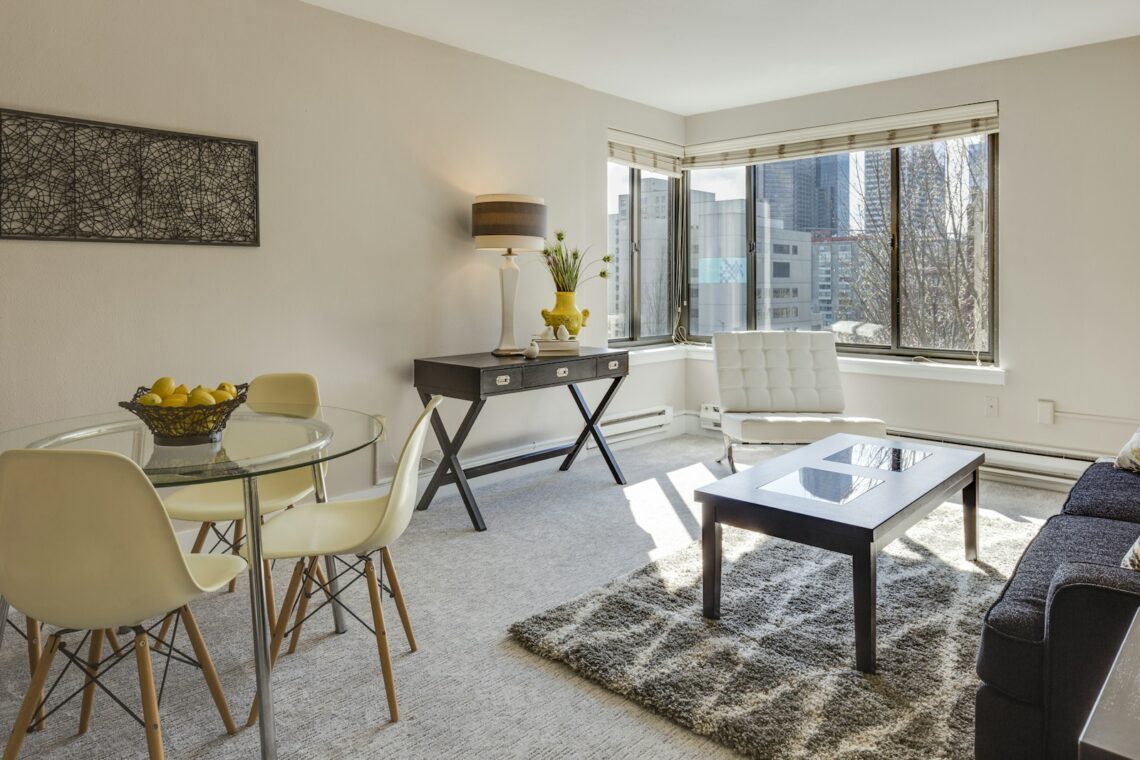
- Eames-style shell chairs: $25 to $80 on Amazon, slim and see-through silhouette
- Lucite or acrylic chairs: visually weightless, $60 to $120 per chair
- IKEA Tobias chair: clear polycarbonate, $60, seats four without visual bulk
The Takeaway
A small apartment living room with dining combo works when you stop fighting the open plan and start using it. Define zones with rugs and pendant lights. Choose a table size that fits the actual available footprint, not the one you wish you had. Use bookshelves and counter stools as the dividers and dual-purpose elements they already are.
You do not need a larger apartment. You need to treat the one you have as two rooms that happen to share walls, floors, and ceilings. Once you frame it that way, every square foot starts working harder.
Start with one change this week: swap out an oversized rectangular table for a 36-inch round, or tape down a rug to define the dining zone. Small pivots in a small space produce results you can see immediately. Pick the idea from this list that requires the least money and do it first. Momentum builds from there, and before long the combo layout you once dreaded becomes the feature that makes guests ask how you pulled it all together.