15 Cozy Vinyl Record Room Ideas for Small Apartments
You live in 600 square feet, your walls are beige, and your landlord has strong opinions about holes. You still want a vinyl setup that sounds incredible and looks like it belongs in an architecture magazine. Good news: a small apartment is one of the best environments for a vinyl listening room. You just need to work with the constraints, not against them.

Why Vinyl Sounds So Good in a Small Apartment
Here is something audio engineers know that most renters do not: smaller rooms often produce better sound for vinyl playback than large open spaces. In a compact apartment, your bookshelf speakers fill the room without needing excessive volume. Sound reflects off nearby walls and creates a natural warmth that a cavernous living room simply cannot replicate at low listening levels.
The math works in your favor. A pair of powered bookshelf speakers rated at 20 watts can fill a 300 square foot studio at conversational volume, which means no noise complaints and no thin, underpowered sound. Vinyl also rewards close listening, and in a small space, you are almost always within the ideal listening distance (six to ten feet from your speakers).
- Small rooms create natural bass reinforcement near walls
- Lower volume needs reduce distortion from cheap amplifiers
- You spend more time near your setup, which makes flipping records effortless
- Condensed spaces feel intentional and curated rather than sparse

Picking the Right Turntable for a Small Space
The turntable market has never been better for apartment renters. You do not need to spend $1,000 to get excellent sound, but you also do not want to drop $80 on a plastic direct-drive unit that will eat your records. The sweet spot for most first-time small-apartment vinyl setups sits between $200 and $450.
The Audio-Technica AT-LP120XUSB ($299) is the most popular starting point and for good reason. It has a built-in preamp (so you can plug directly into any powered speakers without a separate receiver), fits on a surface as small as 14 by 14 inches, and comes with an AT-VM95E cartridge that genuinely sounds good out of the box. For smaller budgets, the Audio-Technica AT-LP60X ($129) strips out some features but still delivers clean, respectable sound for apartments.
- Built-in preamp: Non-negotiable for small spaces; eliminates one more piece of equipment
- Belt drive vs. direct drive: Belt-drive units are quieter (less motor noise) at similar price points
- Semi-automatic or automatic: Automatic tonearm return means you do not have to jump up every 20 minutes; convenient in a small space where your setup might be across the room
- Lid included: Essential in apartments; dust from cooking and open windows destroys needles

Where to Put Your Turntable (Surface and Placement Rules)
Vibration is the enemy of good vinyl playback. In an apartment, foot traffic through thin floors, nearby train lines, and even a washing machine in a shared laundry can cause your needle to skip. Your turntable surface matters as much as the turntable itself.
The best surfaces for apartments: a dedicated vinyl stand with an isolation platform, a solid wood console or credenza with rubber feet, or a wall-mounted shelf. The worst: a washing machine, refrigerator top, hollow Ikea flat-pack furniture (particleboard resonates), or anywhere near a subwoofer.
- Isolation platforms ($30 to $80, IsoAcoustics Deskpads, Vibrapod Isolators): foam or spring-based pads that sit under the turntable and absorb floor vibration
- Wall-mounted shelf: The best solution for thin floors; removes vibration completely because walls flex differently than floors
- Height: Eye level or slightly below keeps the tonearm movement visible and lets you lift the needle without bending awkwardly
- Keep it away from speakers: Speaker vibration feeding back through the floor to a belt-drive turntable causes feedback loops

Carving Out Your Listening Spot
Every great small-apartment vinyl setup has a dedicated listening chair. It does not need to be expensive or large. It needs to be yours, positioned correctly relative to your speakers, and comfortable enough that you will actually sit in it for a full album side (about 20 minutes).
The ideal listening position puts you at an equal distance from both speakers, forming an equilateral triangle. In a small apartment, that distance is often just five to eight feet, which means even a compact loveseat or a single armchair works perfectly. Point the chair slightly toward the center of the room rather than directly at the speakers so the sound wraps around you rather than hitting you straight on.
- The Rule of Thirds: Place your chair one-third of the room’s length from the back wall to reduce bass buildup behind you
- A throw and a side table: The two details that convert any chair into a listening throne; one for warmth, one for your coffee or record sleeves
- Lamp positioning: A warm-toned floor lamp (2700K bulb) behind or beside your chair creates the right mood without overhead harshness
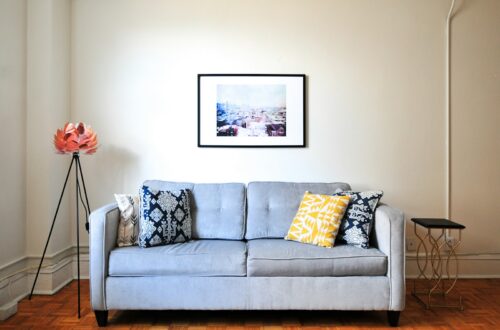
- If you do not have room for a dedicated chair: One end of a couch works; just add a floor lamp to mark the spot visually

Choosing Speakers That Fit Your Small Apartment Vinyl Setup
Bookshelf speakers are the default choice for small apartment vinyl setups, and they are called bookshelf speakers because they were actually designed to sit on shelves. That said, putting them directly on a shelf without stands or isolation pads reduces bass clarity and can cause distortion from shelf resonance.
For turntable use without a separate receiver, you need powered (active) bookshelf speakers. The Edifier R1280T ($99) is the budget entry point and sounds surprisingly competent. The Edifier R1700BTs ($200) adds Bluetooth and better drivers. If you can stretch to $250, the Klipsch R-41PM delivers a substantially more detailed sound with built-in phono preamp.
- Wired vs. Bluetooth: Wired connections have zero latency; Bluetooth adds a slight delay and one more thing to pair
- Speaker placement: At ear height when seated, aimed slightly inward (toe-in), with at least six inches of clearance behind them from any wall
- Isolation pads under speakers: IsoAcoustics Aperta ($40 per pair) dramatically tightens bass on shelves or credenzas
- Total footprint: Most 5-inch bookshelf speakers need a surface roughly 8 by 10 inches each; a standard IKEA Kallax shelf opening is 13 by 13 inches, which fits most models comfortably

Storing Your Records Without Taking Over the Room
Records are large. A single LP is about 12.5 inches square and roughly 0.1 inches thick. Fifty records take up about five inches of horizontal shelf space. Once you hit 200 records, storage becomes a real design challenge in a small apartment.
The trick is to make your storage look intentional. Records displayed vertically on open shelves with a few album covers facing outward become a design feature rather than clutter. An IKEA Kallax (two-by-two or two-by-four configuration) holds approximately 50 to 70 records per cube, has a footprint that fits against any wall, and costs $55 to $110. One cube of a Kallax dedicated to records with the other cubes holding books and plants becomes a styled media wall rather than a music nerd storage dump.
- Record crates under the turntable table: Store the bulk of your collection in wood or metal crates below the playing surface; keep only your current rotation on top or in a small desktop organizer
- Vertical over horizontal: Always store records vertically; horizontal stacking warps records within months
- Inner sleeves matter: Poly inner sleeves ($15 for 50) prevent groove damage from the standard paper sleeves that come with most records
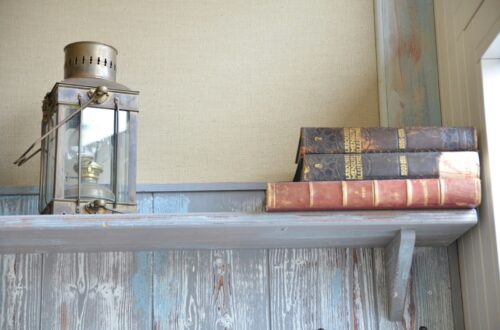
- Floating wall shelves for display: Keep your ten favorite albums propped on a small wall shelf as visual art; rotate them seasonally

Using Album Covers as Actual Wall Decor
This is the design move that turns a small apartment vinyl setup from a hobby corner into a real room identity. Album covers are 12-by-12-inch pieces of graphic design that happen to be culturally meaningful to you. Displaying them on your walls costs almost nothing and looks far more personal than any poster or print you could buy.
The simplest method: wooden display ledges (IKEA MOSSLANDA, $5.99 each) let you lean records without making holes. Arrange three to five covers on a ledge and rotate them whenever you feel like a change. For a more permanent gallery, a set of adhesive Command picture strips can hold a record cover flat against the wall without nails. Some vinyl enthusiasts use acrylic frames designed for LP covers ($8 to $15 each) for a cleaner, framed look.
- Create a grid: Four album covers in a two-by-two arrangement on a bare wall has the same visual impact as a large canvas print
- Mix records with actual frames: One album cover, one film photo print, one plant on a ledge is more interesting than three album covers in a row
- Use duplicates: Never display your only copy of a record; if you want to show it off permanently, buy a second copy for display and keep the good one in a sleeve
- Seasonal rotation: Swap covers every few months; it costs nothing and completely refreshes the room

Building Your Record Collection on a Renter’s Budget
New records at full retail prices are expensive. A new pressing of a classic album runs $25 to $35, and new releases can hit $40. But the used record market is enormous, accessible, and filled with excellent music for $1 to $5 per record. Building a 100-record collection in a small apartment on a budget is completely realistic if you know where to look.
Thrift stores (Goodwill, Salvation Army, estate sales) are the cheapest source but require the most sorting through scratched or undesirable records. Local record shops always have a used bin; you pay more ($5 to $15 per record) but the shop has already curated out the garbage. Discogs.com is the eBay of records, with listings from thousands of sellers and detailed condition grading, usually $3 to $10 shipped for common titles.
- Start with genres that are cheap and plentiful: Classic rock, jazz from the 1960s to 1980s, and soul records are abundant in used bins for $1 to $5 each
- Avoid scratched records entirely: Surface noise from scratches is permanent; hold a record up to light at an angle before buying used
- Record Store Day (April and November): Two annual events when shops release limited pressings; great way to buy new records directly from stores you want to support
- Headphones as a budget alternative: A good pair of headphones (Audio-Technica ATH-M40x, $99) lets you experience vinyl detail at any hour without disturbing neighbors, especially useful in thin-walled apartments

The Takeaway
A small apartment vinyl setup does not require a dedicated room, an expensive receiver stack, or hundreds of records. It requires a decent turntable ($200 to $300), a pair of powered bookshelf speakers ($100 to $250), a surface that does not vibrate, and a chair you actually want to sit in. Start there, add records gradually, and let the room evolve around the music.
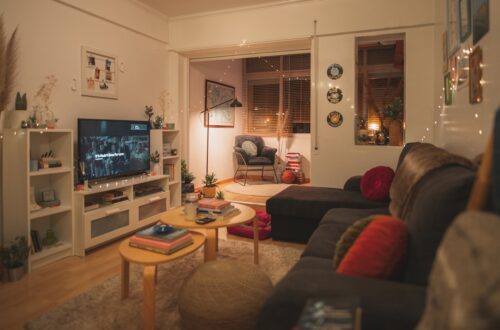
The best small-apartment vinyl rooms look lived in, not curated. A few records propped against the wall, a lamp throwing warm light on the turntable, a half-drunk cup of coffee on the side table. That is the goal. Your collection will grow, your setup will evolve, and each record you pull out will make the space feel more like home. Start with the basics, listen often, and let the room tell you what it needs next.