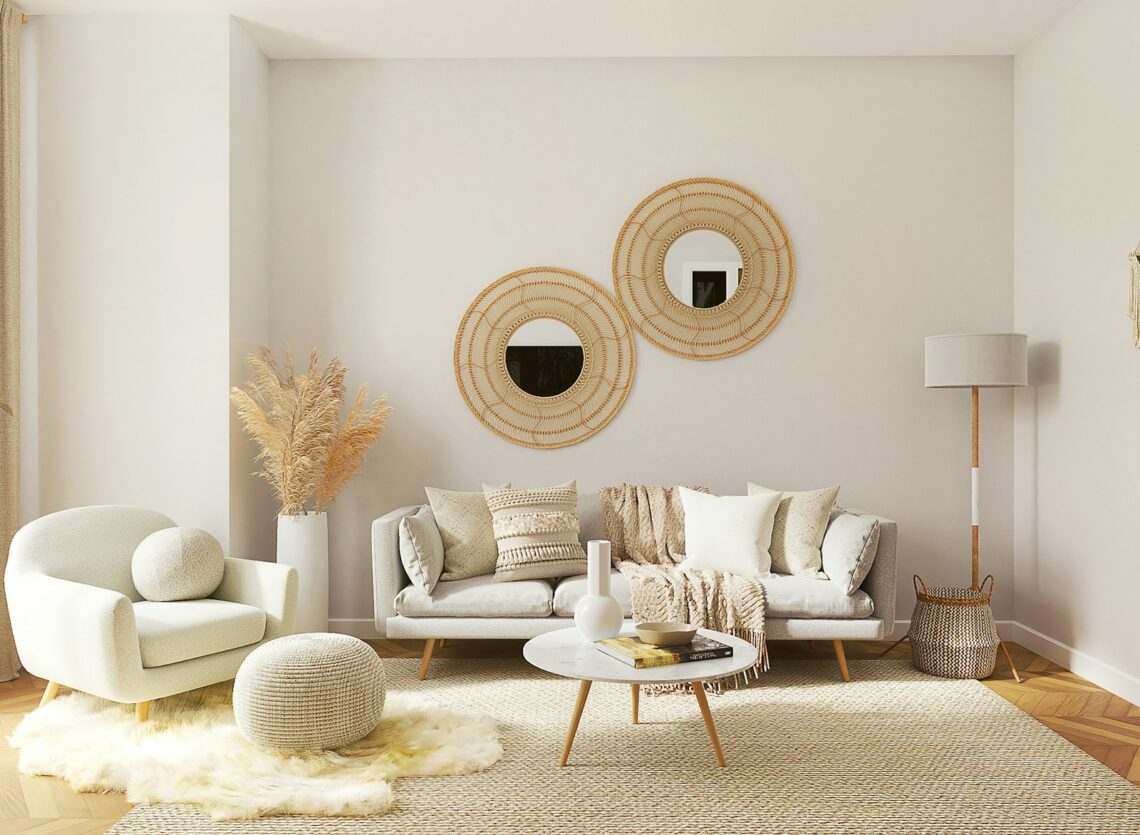

Most renters make at least five of these small apartment decor mistakes without knowing it. The room feels off, nothing looks quite right, and the space always seems smaller than the floor plan suggests. The problem is almost never the square footage. It is the decisions made inside it. Fix these twelve specific mistakes and the same apartment feels completely different.
12 Small Apartment Decor Mistakes That Make Rooms Feel Smaller
Small spaces punish certain decorating choices more harshly than large ones. An oversized sofa that looks fine in a sprawling loft will eat every inch of breathing room in a 450-square-foot studio. A single bare overhead bulb that reads as “minimal” in a big living room turns a small apartment into a waiting room. The good news: every mistake on this list has a straightforward fix, and most cost under $50 to address.
Work through this list room by room. Check your current setup against each mistake. You do not need to overhaul everything at once. Even correcting two or three of these will produce a noticeable shift in how your space feels.

Mistake 1 and 2: Choosing the Wrong Furniture Size and Scale
Mistake 1: The sofa is too large for the room. The single most damaging small apartment decor mistake is a sofa that runs wall to wall. A sectional that looks lush in a showroom will devour a small living room. Before you buy any seating, tape out the footprint on your floor using painter’s tape. Walk around it. Open the door. Check if there is still 30 to 36 inches of clearance for traffic flow. A two-seat or two-and-a-half-seat sofa works better in most apartments under 700 square feet. Look for sofas that max out at 80 inches wide.
Mistake 2: Furniture sits flat on the floor with no legs. Platform sofas, low-slung sectionals, and heavy storage ottomans that sit directly on the floor create a visual wall of mass. Furniture with legs, even short ones at four to six inches, lets light and sight lines pass underneath. This makes the entire room feel taller and more open. Swap a blocky coffee table for one with tapered wood or hairpin legs. Choose a sofa with visible feet. These changes cost nothing if you already own the furniture; a set of furniture leg extenders from Amazon runs about $18.
For more ideas on furnishing a compact living space, see our guide to IKEA finds for small apartments.
Mistake 3 and 4: Getting Your Apartment Lighting Wrong

Mistake 3: Relying on a single overhead light. A single overhead fixture or a bare bulb in the center of the ceiling does one thing well: it exposes every corner of the room in flat, unflattering light. This is the fastest way to make a small apartment feel like a budget motel. Overhead light is useful for tasks. It is not a mood-setter and it is not enough on its own.
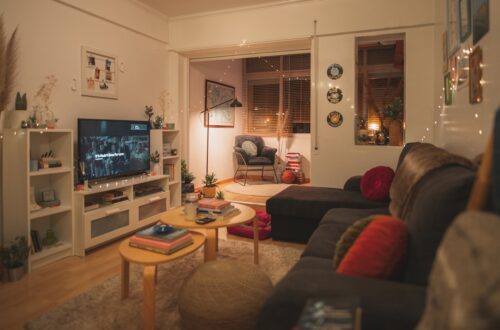
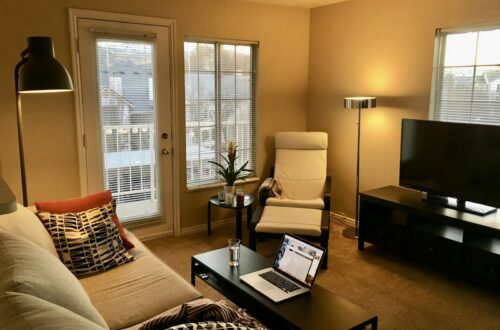
The fix is layering. You need at least three light sources in any room you spend time in: one overhead or ambient light, one task light at a desk or reading chair, and one accent light that adds warmth to a corner or shelf. Floor lamps are the easiest addition. A well-placed arc lamp over a sofa changes a room instantly. Read our full breakdown of arc floor lamps for small apartments to find the right height and reach.
Mistake 4: Using cold or bright white bulbs. The color temperature of your bulbs matters as much as where you place the lights. Bulbs labeled “daylight” or “cool white” (5000K to 6500K) look harsh and clinical in a small space. Swap them for “soft white” or “warm white” bulbs in the 2700K to 3000K range. This single change, which costs about $12 for a four-pack, will make your apartment feel warmer and significantly more inviting.
Mistake 5 and 6: Common Small Apartment Decor Mistakes With Rugs

Mistake 5: Buying a rug that is too small. A 5×7 rug under a standard three-seat sofa and coffee table setup looks like a postage stamp. The rug floats in the middle of the room, emphasizing how small the space is instead of anchoring it. In a living room, you want either all furniture legs on the rug, or at minimum the front two legs of each major piece sitting on it. For most apartment living rooms, that means going up to an 8×10 or even 9×12 rug. Yes, a larger rug in a small room sounds counterintuitive. It works because it defines the space instead of fragmenting it.
Mistake 6: Placing the rug incorrectly. Even the right-sized rug can hurt a room if it is pushed against one wall or centered without any furniture touching it. The rug should sit under the coffee table and pull together the seating area. In a bedroom, the rug should extend at least 18 inches past the sides and foot of the bed so you step onto it when you get up in the morning. A rug that stops right at the bed frame looks like a bathmat.
Mistake 7 and 8: How You Treat Your Walls Matters

Mistake 7: Leaving all the walls bare. Blank walls in a small apartment do not look clean or minimal. They look unfinished. The eye has nothing to rest on, which paradoxically makes the room feel smaller and less personal. You do not need to cover every wall. Pick one main wall per room and give it visual weight. A gallery wall with four to six prints, a single large-format art piece, a mirror, or floating shelves with books and plants all work. The key is intentionality. One considered wall is all it takes to shift a room from “empty” to “curated.”
Mistake 8: Hanging art too high. Art hung at eye level for someone who is six feet tall reads as disconnected and random. The standard rule is to center artwork at 57 to 60 inches from the floor, which is the average gallery height. When art hangs too high, it pulls the eye up awkwardly and leaves the furniture below feeling abandoned. Lower it. If you have a gallery wall, keep the center of the grouping at that 57-to-60-inch mark, not the top edge of the highest piece.
Mistake 9: Blocking the Natural Light You Already Have

Natural light is the most powerful tool a small apartment has. Many renters accidentally cut it in half with the wrong window treatments. Heavy blackout curtains that stay closed during the day, mini blinds left in a half-open position, and curtain rods mounted inside the window frame rather than above it all reduce the amount of light entering the room.
The fix on a budget:
- Mount your curtain rod 4 to 6 inches above the window frame, not at the top of the frame itself. This makes the window look taller.
- Extend the rod 8 to 12 inches past the window on each side so the curtain panels hang beside the window, not over it, when open.
- Swap heavy drapes for sheer or semi-sheer panels in white or linen. These diffuse light without blocking it, give privacy during the day, and make rooms feel airy.
- If you need light control, layer a sheer panel under a heavier blackout panel on the same rod.
This is one of the most impactful small apartment decor mistakes to fix because it costs under $40 and affects how the room feels at every hour of the day.
Mistake 10 and 11: Ignoring Vertical Space and Hidden Storage

Mistake 10: Storing everything at eye level and ignoring what is above it. Most apartments have eight to nine feet of ceiling height. Most storage sits between two and five feet off the floor. That leaves three to seven feet of wall space completely unused. Floating shelves mounted high on the wall, tall bookcases that reach toward the ceiling, and kitchen cabinets extended with stacking shelf units all reclaim this unused vertical zone. Drawing the eye upward also makes ceilings feel higher.
A simple rule: if a shelf could go at six feet instead of four feet, put it at six feet. Use the lower zone for items you need daily. Reserve the upper zone for things you access monthly, or use it purely as display space with plants, books, and small objects that add visual interest without taking up floor area.
Mistake 11: Not using hidden storage opportunities. The space under a queen bed holds roughly 12 to 16 cubic feet of storage. The back of every door in your apartment holds additional shelf or pocket space. Most renters use neither. Start with the bed: invest in a set of bed risers ($15 to $20) to lift it 5 to 8 inches, then use flat bins or rolling drawers underneath. See our full guide to under-bed storage hacks for exactly what to store where.
Mistake 12: Treating Every Piece of Furniture as Single-Purpose

In a small apartment, every piece of furniture should do at least two jobs. A sofa that is only a sofa, a coffee table that is only a surface, a nightstand that holds only a lamp: these are missed opportunities. The best small apartment furniture setups layer function without adding visual clutter.
Examples of multifunctional swaps that actually work:
- Replace a solid coffee table with one that has a lower shelf or lift-top storage. Price point: $80 to $150.
- Use an ottoman with a removable lid and interior storage instead of a standalone footrest. It also functions as extra seating for guests.
- A narrow console table behind the sofa works as a desk, a bar cart zone, and a display surface all at once.
- A storage bench at the foot of the bed replaces a hope chest, handles overflow blankets and pillows, and doubles as a seat when dressing.
- In a studio, a bookshelf placed perpendicular to the wall creates a visual room divider without walls and adds storage simultaneously.
Multifunctional thinking is what separates apartments that feel cramped from ones that feel thoughtfully designed, regardless of square footage.
Plants and a Personal Layer Are Not Optional

Generic decor makes a small apartment feel like a hotel room. The last layer, after furniture, lighting, storage, and wall decor, is the personal one. This means actual plants (not faux), a few objects that are specific to you, and a color or pattern that you chose intentionally rather than because it was the safest option on the shelf.
Plants deserve special mention. A single pothos on a shelf, a snake plant in a corner, or a trailing plant above a kitchen cabinet adds a living texture that no throw pillow can replicate. Plants also improve air quality, which matters more in smaller, less-ventilated spaces. If your apartment has very little natural light, peace lilies, ZZ plants, and cast iron plants all tolerate low-light conditions well.
The personal layer also includes things like a stack of books you have actually read, a ceramic piece from a trip you took, a lamp you bought because you loved it rather than because it was cheap. Small apartments that feel like homes rather than showrooms are ones where the person living there is visible. Do not decorate around yourself.
The Takeaway
The twelve small apartment decor mistakes covered here all share one root cause: treating a small space like a shrunken version of a large one. Small spaces need decisions that are more intentional, not fewer of them. Scale every piece of furniture before you buy. Layer your lighting. Size your rug to anchor the room, not just fill a corner. Get curtains up high and wide. Use the vertical space above eye level. Make every piece of furniture earn its floor space by doing more than one job. Add one strong wall moment per room. Bring in a plant and something personal.
None of this requires a renovation or a large budget. Most of it requires a measuring tape, a few hours on a Sunday, and the willingness to move things around until the room stops feeling like a mistake.