Small Bedroom Ideas for Tall People (6 Ft+)
If you are 6 feet tall or taller, most bedroom advice was not written for you. Standard furniture sizing, common storage hacks, and typical layout guides all assume an average height. That leaves taller renters with beds that cut off their feet, shelves set too low, and workspaces that wreck their posture. These small apartment bedroom ideas for tall people start from the correct baseline.

Why Standard Bedroom Advice Falls Short for Taller Renters
Most small bedroom guides focus on making a room feel bigger by keeping furniture low. Floating shelves at eye level for a 5-foot-6 person land at chest height for someone who is 6-foot-2. Low-profile beds that look sleek in photos make daily entry and exit harder on taller frames. Furniture sold as space-saving often misses the mark because the measurements that define compact for one body type are cramped for another.
Before you buy anything, measure your actual bedroom ceiling height. In older apartment buildings this is often 8 feet, occasionally 9. That number determines how high your open storage can go. Also measure the wall span opposite your door and any alcove or nook space. Taller people can use head-height wall space that most people leave completely empty.
Key things to audit before you redesign your bedroom:
- Ceiling height (ideally above 8 feet for practical tall-person storage)
- Bed wall clearance on each side
- Door swing radius and hallway access
- Distance from bed edge to the opposite wall
- Your own height plus 6 inches compared to your current mattress length
That last measurement matters more than most guides acknowledge. A standard queen mattress is 80 inches long. If you are 6-foot-2 (74 inches), that gives you exactly 6 inches of clearance. For anyone taller, a California king at 84 inches is worth the investment from day one.
Pick the Right Bed Frame Height for Your Build

The most important single purchase decision for a tall person in a small bedroom is the bed frame height. Frames that sit very low to the floor look minimal and clean but create two real problems: getting in and out requires significant hip flexion every single day, and under-bed storage becomes nearly impossible with less than 6 inches of clearance.
Aim for a bed frame with legs that put the top of the mattress at 25 to 30 inches from the floor. That is slightly higher than the standard 24 to 25 inches, but it gives your frame room to work with. Platform frames with built-in storage drawers typically hit this range and do double duty as the only dresser in the room.
What to look for in a bed frame suited to taller bodies:
- Total mattress height (frame plus mattress) of 25 to 30 inches
- At least 10 inches of under-bed clearance for rolling storage containers
- A frame length that accommodates a California king or king mattress
- Solid wood or steel construction rather than hollow particleboard
- Side rails that extend at least 75 inches to match a longer mattress
Avoid ornate headboards with fixed posts set to standard frame dimensions. If you want a headboard, go with a wall-mounted upholstered panel you can position at the exact height that works for your frame. A headboard mounted 2 to 3 inches above the top of your pillow stack looks intentional and does not require wrestling with the headboard slot on a budget frame.
Add Shelving Above Bed Level to Free Up Floor Space

Floor space is the most limited resource in any small bedroom. Taller people can access wall space that shorter occupants cannot reach without a step stool, which means you have a genuine storage advantage. Use it.
Install floating shelves starting at around 6 feet 4 inches off the floor. At that height, items are at or just above eye level for most people over 6 feet and require no overhead reaching during daily use. The space between those shelves and the ceiling, often 18 to 24 inches, becomes ideal for items you need less frequently: spare linens, seasonal clothing in vacuum bags, stacked books you plan to read.
For above-the-bed shelf placement, use 10-inch-deep shelves so nothing hangs over the sleeping area. Secure shelves to wall studs using appropriate anchors. Command strips are not rated for the load of books or folded clothing and will pull free.
Good uses for above-bed shelving in a tall-person bedroom:
- Library-style book display with spines facing out
- Rolled towels or folded extra blankets in matching baskets
- Seasonal items in labeled clear bins
- Small trailing plants like pothos in lightweight ceramic pots
- Display objects that give the room personality without taking floor space
This approach, combined with a bed frame that has under-mattress drawers, gives you three distinct storage zones: under the bed, the bedside nightstand, and above-head floating shelves. That is a lot of storage in a room without a walk-in closet.
Think Vertical: Small Apartment Bedroom Storage Tall People Actually Use

The wall space between 6 and 8 feet high is underused in almost every apartment bedroom. Most storage furniture tops out at 72 inches, which means the top 12 to 24 inches of your walls are empty by default. In a small apartment bedroom, that gap costs you real usable volume.
Tall freestanding shelving units are the simplest fix. IKEA Billy bookcases come in a 93-inch height option. Pair them with the glass-front OXBERG add-on to make them look built-in. Anchor them to the wall stud with a furniture safety strap regardless of how stable they feel freestanding.
Modular wall-rail systems like ELFA or IKEA BOAXEL are a second option. These mount to the wall at whatever height you choose and accept shelves, drawers, and hanging rods at any position along the rail. They are renter-friendly because you only patch a few screw holes when you move, and the whole system travels with you.
A simple tall-storage configuration for a small apartment bedroom:
- Two vertical rails anchored to studs, 24 to 36 inches apart
- Top shelf at near-ceiling height for bulky, infrequently used items
- Middle shelves at 5 to 7 feet for daily-use items and curated decor
- A hanging rod at 5 to 5.5 feet for short garments and accessories
- A second lower rod for full-length items if needed
This configuration replaces a bulky wardrobe and keeps the floor beneath it open for shoes, a small hamper, or a floor lamp.
Layer Your Bedroom Lighting So No Single Fixture Has to Do Everything

A single overhead light in a small bedroom creates one flat wash that flattens the room visually and feels institutional. Layered lighting from multiple sources at different heights creates warmth, depth, and makes the space feel like someone designed it on purpose.
For tall people specifically, the overhead fixture is often at or near face level when standing. A pendant that clears 7 feet 6 inches for a 5-foot-8 person may put the bare bulb directly in your line of sight at 6-foot-3. Choose flush-mount LED fixtures or semi-flush mounts that direct light upward rather than a bare pendant that dips low into your visual field.
A layered small bedroom lighting plan that works for taller bodies:
- Ceiling: flush-mount LED in 2700K for a warm tone, or recessed puck lights if your lease allows
- Beside the bed: wall-mounted swing-arm sconces so the nightstand stays clear and the light source sits at pillow height
- Corner: a tall arc floor lamp positioned behind a chair or at the foot of the bed
- Work area: an adjustable-arm desk lamp with a 4000K daylight bulb for focused tasks
For a deeper look at apartment bedrooms with no ceiling fixture at all, see How to Light an Apartment Without Overhead Lights. It covers no-overhead setups from scratch with specific product recommendations for renters.
Pick a Mattress Length That Actually Fits Your Body

A standard queen mattress is 60 by 80 inches. If you are 6-foot-2, that 80-inch length leaves 2 inches of clearance, which disappears the moment you stretch in your sleep. A California king at 72 by 84 inches adds 4 more inches of length and is the correct default choice for anyone over 6-foot-1 who is not severely constrained by room width.
The tradeoff: a California king is slightly narrower than a standard king (72 inches versus 76 inches). Before committing, measure whether the frame fits through your apartment door and hallway. Many California king frames ship in sections for this exact reason.
Measurements to take before buying a mattress for a tall-person bedroom:
- Apartment doorway and hallway width (standard doorway is 30 to 36 inches)
- Clearance on each side of the bed once placed (aim for 24 inches on the dominant side, 18 on the wall side)
- Ceiling height if you plan a tall platform or canopy frame
If your bedroom is too small for a California king, a 2-inch mattress topper on a standard king effectively adds length at the foot for around $50, which is worth trying before committing to a full upgrade.
Build a Wardrobe System That Works Without a Walk-In Closet

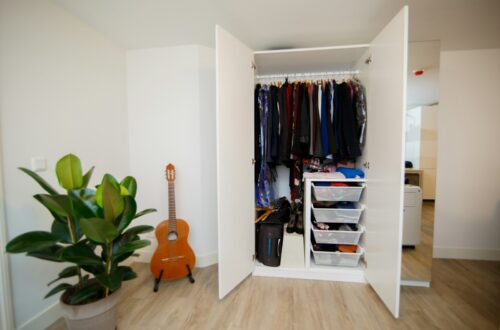
Closet space is already tight in most apartments. For taller people, the problem compounds: standard double hang rods are set at heights that leave garments dragging, and single-hang sections often max out at 68 to 72 inches, meaning pants on hangers sit bunched at the bottom.
The fix is a modular open wardrobe system you configure yourself rather than a prebuilt cabinet. Open rail systems let you set every rod at the exact height your clothing requires. A good small apartment wardrobe setup for tall people:
- Top rod at 70 to 72 inches: full-length dresses, coats, trousers on full-length hangers
- Middle rod at 54 to 56 inches: shirts, jackets, and shorter items doubled up
- Below middle rod: a row of deep baskets for folded knits and workout gear
- Top shelf above everything: vacuum-packed off-season clothing and extra bedding
For rooms with no closet at all, a slim rolling garment rack plus a Kallax shelf unit covers most storage needs at a combined cost of under $200. For a full breakdown of closet-free setups, 17 No-Closet Bedroom Ideas Every Renter Needs covers the range from curtained alcoves to full freestanding systems.
Keep the floor beneath the hanging section clear for a shoe tray or a low rolling drawer unit. Taller people tend to wear larger shoe sizes that take up more floor space per pair, so a simple two-tier shoe rack mounted at the bottom of the rail system keeps things tidy without sprawl.
Set Up a Workspace That Protects Your Posture

A bedroom desk in a small apartment often doubles as the only home office. For tall people, standard desks at 29 to 30 inches create ergonomic problems fast: shoulders hunch upward, elbows angle outward, and the neck cranes down to read a screen at a monitor set too low. Those issues compound over a full workday and show up as chronic upper back tightness.
Optimal desk height for someone 6 feet or taller is 31 to 34 inches. Adjustable-height desks solve this precisely. Standing desk converters that sit on top of a standard desk are a less expensive option but add visual bulk in a small room.
Small bedroom workspace setups that work well for taller bodies:
- Wall-mounted fold-down desk at 33 inches: folds flat when not in use and saves floor space entirely
- Bar-height desk at 42 inches with a drafting stool: works as a standing desk for calls and a seated desk for focused work
- Standard desk raised with 2-inch furniture leg risers: brings a 29-inch desk to 31 inches for around $15
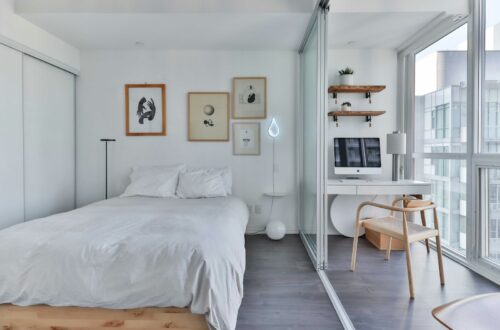
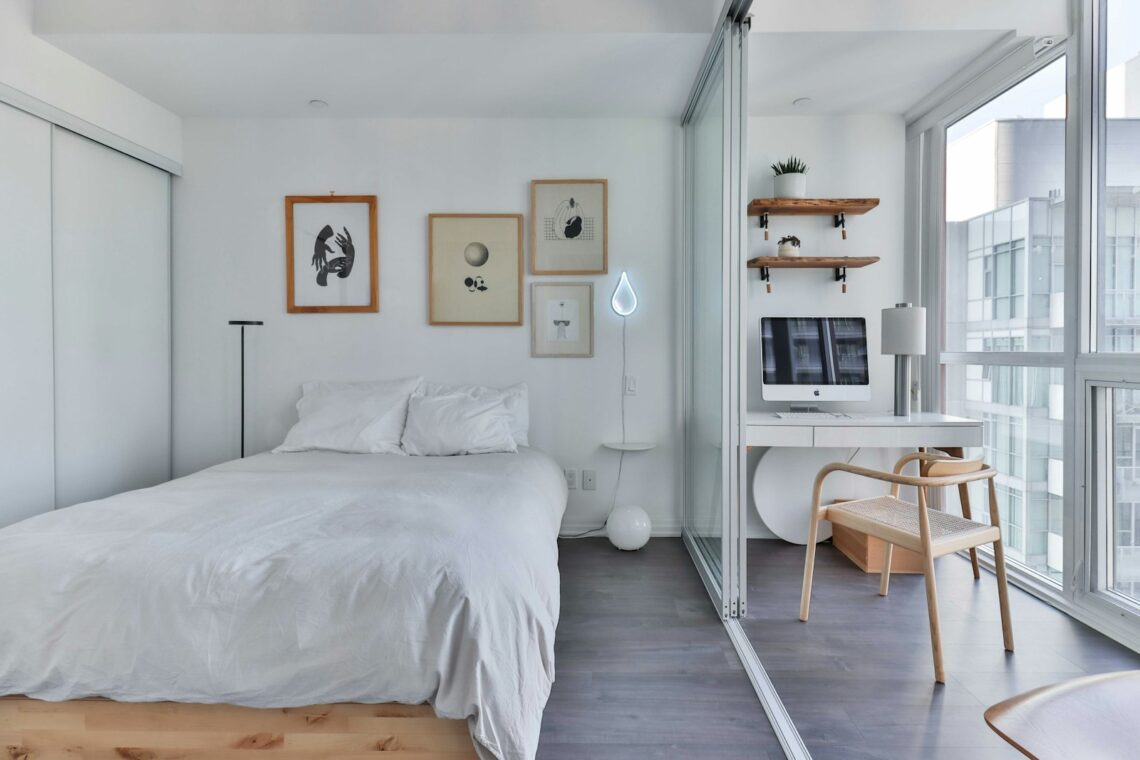
- Corner desk placed in an alcove: uses a dead corner and creates a visual separation between work and sleep zones
Pair any setup with a monitor arm that raises the screen to eye level. For a 6-foot-1 person seated at 33 inches, eye level when sitting is roughly 50 to 52 inches off the floor. A monitor on an arm set at that height eliminates neck strain without adding desk surface clutter. For broader storage ideas around a small desk, 35 Small Apartment Storage Hacks That Actually Work covers compact desk wall storage in detail.
Use Rugs and Soft Layers to Define Zones Without Adding Bulk

In a small bedroom, the goal is not to add more items but to make the items already there feel purposeful. Rugs do this better than almost any other single element. A large rug under the bed (8 by 10 feet minimum for a room with a queen or king) anchors the sleep zone, adds warmth underfoot when you step out in the morning, and corrects the proportion problem that happens when tall furniture makes a small room feel top-heavy.
Choose rugs with a low pile (under half an inch) in small bedrooms. High-pile rugs feel plush but collect dust and make the room feel smaller. A flat-weave cotton rug in a neutral geometric pattern reads as intentional without competing with bedding or wall color.
Beyond the rug, layering soft elements adds depth and visual interest without taking floor space:
- Two large euro pillows plus two standard pillows in matching shams give the bed visual height that reads well for a taller frame
- A folded throw at the foot of the bed in a contrasting texture breaks up the monotony of one large flat surface
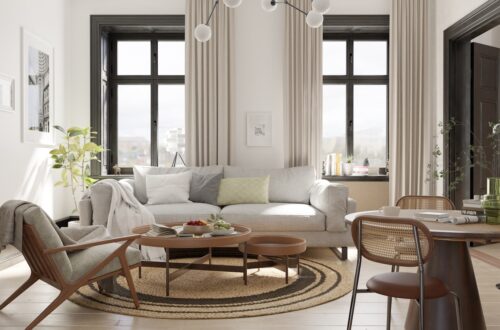
- Linen curtains hung from ceiling height rather than just above the window frame draw the eye up and make any room feel taller
- Framed art arranged in a vertical grouping or stacked gallery wall pulls the gaze upward rather than across
- A single large plant in a statement pot near the window adds a vertical element that costs nothing in floor plan area
Curtains hung at ceiling height are one of the highest-impact changes in any small bedroom. Moving the rod from just above the window frame to 2 inches below the ceiling creates the impression of a full-height window and makes the ceiling feel taller to anyone entering the room.
The Takeaway
A small apartment bedroom that works for a tall person requires a different checklist than the standard advice assumes. Start with the bed: get the right length and the right height off the floor, because that single decision shapes everything else. Then work upward, using the wall space above 6 feet that most guides leave completely unused. Layer your lighting, configure your storage for your actual wardrobe needs, and dial in a desk setup that protects your posture over a full workday.
The goal is a room that feels comfortable at 6-foot-2, not a room built for someone a head shorter that you are trying to retrofit. Every fix on this list is renter-friendly, most cost under $200, and none require your landlord’s permission to implement.
For more budget-conscious bedroom upgrades, see 21 Small Bedroom Ideas Under $200 for a full breakdown of changes that move the needle without draining your savings.
Related Reading: