15 Privacy and Security Ideas for First-Floor Apartment Renters
Living on the first floor comes with a trade-off most apartment hunters overlook until after move-in: you are the easiest unit to see into, and the easiest unit to access. Strangers walk past your windows at eye level. Your front door faces foot traffic instead of a hallway. That does not mean you are stuck with blinds permanently drawn and a low-grade sense of unease. These 15 small apartment first floor security ideas are all renter-friendly, most cost under $50, and several take under an hour to implement.

First-Floor Apartment Security Starts at Your Door
The front door is the first thing any would-be intruder evaluates. Most apartment door failures happen not because the lock is cheap, but because the door frame is weak. A standard strike plate held in with short screws can be kicked in with a single strong hit. Two upgrades fix this without touching a single structural element you are not allowed to modify.
Upgrade your strike plate. A heavy-duty reinforced strike plate (brands like Door Armor or Door Armor MAX, $25-40) replaces the standard plate with a 4-inch steel version secured with 3-inch screws that reach the stud behind the frame. This is completely reversible and most landlords consider it an improvement, not damage. Ask before you install, and keep the original hardware in a labeled bag.
Add a door security bar. A door barricade bar (like the Master Lock Security Bar, around $30) wedges under the door handle and braces against the floor. It requires zero installation and removes in seconds. This is particularly useful at night. It will not stop a determined person from eventually getting through, but it adds enough resistance to make the attempt impractical.

Window Privacy Fixes Every First-Floor Renter Needs
Eye-level windows are the defining challenge of first-floor apartment living. The goal is not to black out every window and live in a cave. It is to control the sightlines so that passersby cannot see in, while you can still see out and light can still come in.
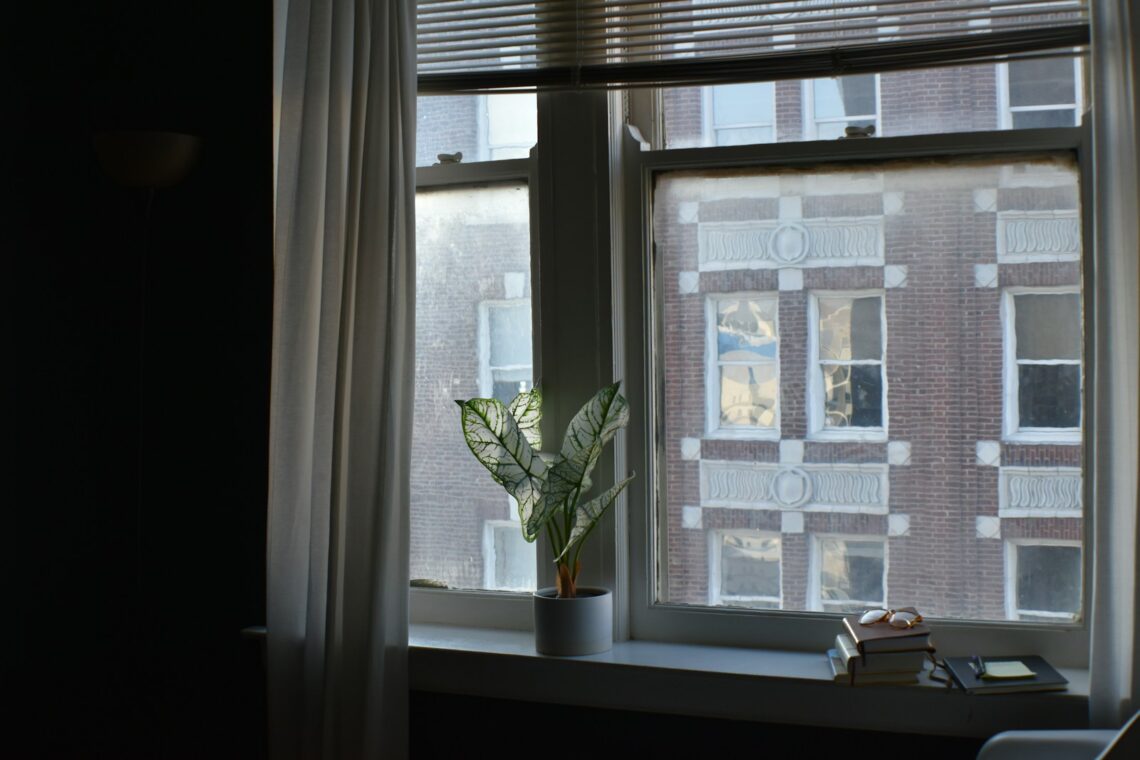
The layered curtain method. Hang sheer curtains on tension rods closest to the glass. Sheers diffuse light beautifully, let daylight flood in, and make it genuinely difficult for anyone outside to see into a lit interior during the day. Add a second rod with blackout or heavier linen panels further back. Pull the heavier curtains closed at night, when interior lighting creates a stage effect where you can see in clearly from outside. No tools, no holes, no deposit risk.
Window stops. Standard windows can usually be opened fully, which is both a ventilation feature and a vulnerability. Sash locks and window stops (around $5-8 each at hardware stores) limit how far a window can be opened to 4-6 inches. You get airflow. You eliminate the ability for someone to climb through. Install them yourself, they snap or screw into the window frame with no permanent modification required in most cases.

Window Film: The $20 Fix That Transforms Your Space
Window privacy film is the most underused renter upgrade available. A roll of frosted or one-way privacy film from Amazon runs $15-25, covers a standard window, and takes 20 minutes to apply with a squeegee and some soapy water. It peels off cleanly when you move.
Apply it to just the lower third or half of a window and you get full privacy for anyone walking past at street level, while the upper portion of the window continues to let in light. You can see out. No one can see in. During the day, one-way film works especially well because the exterior is brighter than the interior. At night, turn on lamps away from windows rather than directly behind them, since the effect reverses in low light.
Decorative frosted film (botanical patterns, geometric designs, textured looks) has the same functional privacy properties as plain frosted film and looks intentional rather than defensive. Search “privacy window film renter” on Amazon for options under $20 that work on standard double-pane glass. Avoid adhesive films, which can pull up window coatings. Stick to static-cling versions.

Door Chain and Deadbolt: What You Can Ask Your Landlord For
Many renters do not know that in most US states, landlords are legally required to provide working deadbolt locks on exterior doors. If your apartment has only a knob lock or a single-cylinder deadbolt, you can ask your landlord in writing to upgrade the hardware. Frame it as a repair request rather than a renovation request. In Texas, California, New York, and most other major states, this is covered under warranty of habitability laws.
If the landlord is slow to act, you can often install a door chain yourself and disclose it. Door chains cost $8-15 and require only a screwdriver. A chain or swing bar restricts door opening even when someone has a key copy you did not authorize. This matters specifically on first floors where copied keys from former tenants are a real risk. Keep the original hardware, reinstall it when you leave, and take photos before and after.

Small Apartment First Floor Security Tech That Actually Works
Smart security technology has gotten genuinely affordable and renter-friendly over the last few years. You do not need hardwiring, a subscription, or a contractor.
Indoor security camera ($25-50). A Wyze Cam or Blink Mini placed at eye level near your front door or main window gives you a live feed and motion alerts on your phone. Both mount with adhesive pads or a small screw. The Blink Mini runs on battery, meaning no cord is visible. At $35, it is the cheapest deterrent available. If someone does try your door, you have footage.
Window and door sensors ($8-15 per sensor). Magnetic contact sensors (SimpliSafe, Ring, or generic Zigbee sensors) alert your phone the moment a window or door opens. They require no drilling, attach with adhesive, and run on button batteries for 12-18 months. Put one on every ground-floor window and your front door. If you are home and a window opens unexpectedly, you know immediately. If you are out, your phone buzzes within seconds.
Video doorbell without wiring. The Blink Video Doorbell and Eufy Video Doorbell both offer battery-powered versions that require no wiring and attach with screws or adhesive mounts. Some landlords will install a doorbell screw plate if asked. These let you see and talk to whoever is at your door from anywhere. For first-floor units where strangers can approach your door directly from the street, this is a meaningful upgrade.

Plants as a Natural Privacy Barrier
This is the most aesthetically satisfying fix on this list. Tall indoor plants placed in front of ground-floor windows break sightlines from the street while adding humidity, air quality, and a genuinely cozy look. The goal is height and density, not volume.
For a window with direct light, a tall fiddle-leaf fig, bird of paradise, or monstera in a large 12-14 inch pot reaches 4-6 feet and fills most of the lower window when positioned correctly. For low-light situations, cast iron plants and tall snake plants work well. Line a window ledge with smaller plants to fill the gap between the pot and the sill. If you are not into maintaining plants, high-quality faux versions from IKEA or Afloral serve the same visual purpose without the watering schedule.
Outside, if your unit has any access to a patio or small outdoor strip, a row of ornamental grasses, tall boxwoods, or climbing plants on a trellis creates a much more significant visual barrier than any curtain. Talk to your landlord first. Many will say yes if you frame it as improving curb appeal and agree to maintain the plants.

Strategic Lighting: Deter Intruders and Control What People See
Lighting is a two-sided tool for first-floor renters. Done wrong, it makes you more visible. Done right, it makes your space less appealing as a target and limits what people can see from outside at night.
Keep interior light sources away from windows at night. A lamp placed directly behind a thin curtain creates a backlit silhouette effect. Move floor lamps and table lamps to interior walls or corners. Recessed lighting and ceiling fixtures are better choices for windows-adjacent rooms in the evening.
Motion-activated plug-in lights for entryways. A plug-in motion sensor night light ($10-15, brands like GE or Mr. Beams) in an entryway, porch, or common area near your door turns on when it detects movement. This both serves you as a safety light and signals that movement near your door is being detected. Intruders prefer dark, unmonitored entry points.
Smart bulbs on timers. A $12 smart bulb in a living room lamp set to turn on and off at varied times creates the appearance of occupancy when you are away. This is one of the oldest deterrents in the book because it works. Schedule lights for 6pm-10pm with some variation so it does not look like an automated pattern from outside.

Building Relationships That Actually Protect You
No lock, camera, or curtain is as reliable as having neighbors who notice when something is wrong. First-floor apartments are the easiest in the building to check on from the outside, which means a neighbor who knows your routine is a genuine asset.
Introduce yourself to the apartment directly above you and on either side within the first two weeks of moving in. Exchange numbers if they are willing. Let them know your general schedule: “I’m usually home by 7pm and I work from home on Wednesdays” gives them enough to notice when something seems off. This is not paranoia. It is the most human and effective security upgrade you can make.
If your building has a manager or super, introduce yourself there too. Building staff often notice unusual activity near ground-floor units before residents do. They are more responsive to concerns from tenants they know by name. A two-minute introduction on move-in day pays dividends for as long as you live there.

What to Check and Ask Before You Sign a First-Floor Lease
If you are still apartment hunting, a few specific questions before signing can save months of retrofitting later.
- Are the window locks functional? Test every window yourself. Broken latches are common in older buildings. Ask for them to be fixed before move-in as a condition of the lease.
- What is the deadbolt situation? A single-cylinder deadbolt is baseline acceptable. A double-cylinder deadbolt (keyed from both sides) is ideal for a first-floor front door. Ask if the locks have been rekeyed since the last tenant. Most landlords will rekey for free if asked.
- Is there a peephole? First-floor front doors are at street level. A wide-angle peephole (or a digital one you can check from your phone) matters more than in an upstairs unit where you can hear people coming up stairs first.
- How visible is the unit at night? Visit the apartment after dark before signing. Walk by from the street. What can you see through the windows? This tells you exactly what kind of curtain or film investment you are looking at.
- What is the building entry protocol? A building with a key-fob entry vestibule is meaningfully different from one where anyone can walk directly to your door from the sidewalk.
The Takeaway
First-floor apartment living is not a security compromise you have to just accept. The 15 ideas above break down into four categories: door reinforcement (strike plate, bar, chain), window management (film, sheers, stops), low-cost tech (sensors, cameras, smart bulbs), and the human layer (neighbors and building staff). Most renters need items from at least three of those four categories to feel genuinely comfortable on a ground floor.
Start with door and window basics since those are the actual access points. Add a camera and contact sensors for the digital layer. Then layer in plants and curtains to make the space feel private rather than barricaded. A first-floor apartment done right is cozy, well-lit, and full of plants. It just also happens to have a reinforced door frame and a chain lock.
For more on managing apartment challenges specific to location and layout, see 12 Privacy Solutions for a Small Apartment Balcony, 15 Renter-Friendly Noise Solutions for Apartments with Thin Walls, and 11 Ways to Survive Noisy Upstairs Neighbors.