12 Dining Setups for Small Apartments Without a Dining Room
No dedicated dining room? No problem. Most studio and one-bedroom apartments skip the formal dining area entirely, and if you are eating meals balanced on the couch right now, you are in good company. These 12 small apartment dining setups prove you do not need a separate room to have a real, functional spot where you can sit down, eat comfortably, and even host a friend or two.

Why Small Apartments Have No Dining Room (and Why That Works in Your Favor)
Builders and architects dropped the dedicated dining room from small apartments decades ago. In a 400 to 700 square foot space, a separate dining room would consume a quarter of your total floor plan just to hold a table and chairs you use for maybe 45 minutes a day. Removing it frees up the rest of your layout for a kitchen you can actually move around in, a living area with breathing room, and a bedroom that fits more than just a bed.
The result is that small apartment dining works best when you treat the dining spot as something that gets layered into your existing space. The setups below do exactly that. Each one doubles the purpose of a surface, a corner, or a zone you already have, so your square footage works harder without feeling crowded.
Before you choose a setup, run through three quick questions. How many people do you usually feed at once? Do you cook at home most nights or mostly order in? And how much floor space can you dedicate to a table that stays out all the time versus one that folds away? Your answers will narrow down the list fast.
Setups 1 and 2: The Kitchen Counter Bar and Stools

The single most efficient small apartment dining solution is a peninsula or kitchen island with two bar stools. If your kitchen already has a counter that juts out or wraps into the living area, you are halfway there. Pull up stools and that counter becomes your table, your bar, your prep space, and the place guests congregate when you cook.
Setup 1 is the standard bar: your existing counter height (usually 36 inches) paired with bar-height stools at 28 to 30 inches. Setup 2 adds an overhang. If your counter is only 24 inches deep, ask your landlord if you can add a 10-inch butcher block extension, or look for a narrow freestanding island on wheels you can slide into position. IKEA’s Kallax with a butcher block top is a popular sub-$150 version of this idea.
What makes bar stools work is that they tuck almost completely under the counter when not in use, so they contribute almost zero dead space to your floor plan. Backless stools push under all the way. Cross-base stools (like the IKEA Ingolf) are stackable if you need to store one. For a studio where every inch counts, this is often the first setup to try before buying any furniture at all.
- Best for: solo renters or couples who eat most meals at the kitchen
- Budget: $50 to $150 for a pair of stools
- Watch out for: counter height versus stool height mismatch (measure before you order)
Setups 3 and 4: A Small Round Table in the Living Room

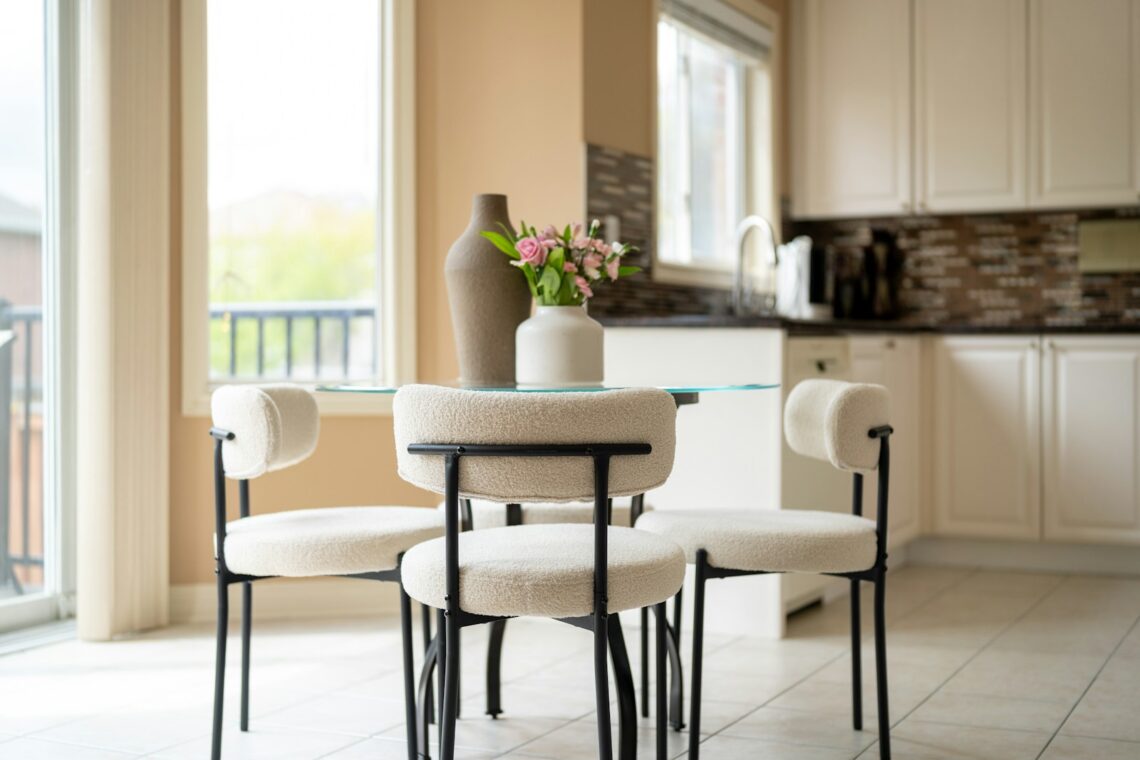
A round table with two to four chairs tucked into the living room is the most versatile small apartment dining setup on this list. Rounds have no corners to catch hip bones, they seat one more person than their footprint suggests, and they leave sight lines open so the room never feels chopped up.
Setup 3 is the 28-inch round: a two-person bistro table that fits into any corner, next to a window, or floating beside the sofa. The IKEA Docksta (white tulip style, $149) and the Hay About a Table are popular picks. Add two lightweight chairs you can move to the sofa area for guests and the table essentially disappears into the room.
Setup 4 is the 36-inch round: seats four tightly or three comfortably, without taking up much more floor space than setup 3. The key is choosing chairs that stack or nest. Acrylic ghost chairs, IKEA Nolmyra chairs, and metal cafe chairs all tuck in flat. A round table at this size in a corner next to your sofa replaces a dedicated dining room for most entertaining needs. For more ideas on blending these two zones, see the guide to cozy living room dining room combo ideas for small apartments.
- Best for: people who eat at a table regularly and occasionally host guests
- Budget: $80 to $300 for table, $20 to $80 per chair
- Watch out for: round tables feel larger than they measure, so tape out the diameter on your floor first
Setups 5 and 6: Fold-Down and Drop-Leaf Tables

If you need a dining surface but cannot spare permanent floor space, wall-mounted fold-down tables are your best friend. Setup 5 is the simplest version: a bracket-mounted shelf or Murphy-style table that folds flat against the wall when not in use. Mounted at table height (29 to 30 inches), a 24 by 36 inch surface seats two people and uses zero floor space when folded. IKEA Norberg ($40) is the entry-level option. The Skovby SM40 is the premium version that seats six when open.
Setup 6 is the drop-leaf dining table: a freestanding table with one or two hinged leaves that fold down when not in use. Folded, many drop-leaf tables are only 10 to 12 inches deep and can live against a wall like a console table. Opened, they expand to a full 35 to 48 inch diameter. The IKEA Norden gateleg table and the West Elm Penelope both do this well. Pair with folding chairs that hang on a closet hook or stack in a corner, and you have full dinner-party capability on zero permanent footprint.
For apartments where space is so tight that every piece of furniture needs to do two or three jobs, consider pairing either of these table types with other transforming pieces. The full breakdown of multi-purpose options is in this guide to convertible furniture ideas for tiny apartment renters.
- Best for: renters who cook or eat at a table a few times a week but need the floor space back daily
- Budget: $40 to $250 for the table, $20 to $60 per folding chair
- Watch out for: wall-mount tables require studs or wall anchors rated for the load
Setups 7 and 8: The Open-Plan Small Apartment Dining Zone

Open-plan small apartments are the most common layout for renters in cities. When the kitchen, dining area, and living room all share one rectangle, the dining zone lives between the two: near enough to the kitchen that carrying food is easy, far enough from the sofa that the couch does not double as extra seating for the table (which causes the whole space to feel like one muddled room).
Setup 7 defines this zone with a rug. A flat-woven rug under the dining table creates a visual room within the room without adding a wall or partition. The rug should be large enough that chair legs stay on it even when chairs are pulled back: typically 5 by 8 feet for a two-to-four-person table. A jute, cotton flatweave, or low-pile synthetic all work and clean easily.
Setup 8 adds a pendant light over the table to anchor the zone from above. A swag-mount cord pendant ($30 to $80) plugs into any ceiling outlet or can hang from a ceiling hook with a cord cover along the wall. Drop it 30 to 36 inches above the table surface. The pendant acts like a visual canopy that says this is the dining area, without walls. Combine the rug and the pendant and you have a fully defined dining zone that disappears into the open plan rather than fighting it.
- Best for: apartments where the living and dining areas already share one open room
- Budget: $30 to $150 for rug and pendant combined
- Watch out for: rug pile height matters if chairs have no wheels; low pile is much easier to slide chairs on
Setups 9 and 10: The Cozy Kitchen Nook

Many apartments have a small dead zone right beside the kitchen: a corner where the counter ends, a few feet of wall between the kitchen opening and the living room, or a narrow pass-through that goes nowhere useful. Setup 9 turns that dead zone into a two-person eating nook.
The secret is scale. A 24 by 32 inch rectangular table takes up less floor space than most nightstands and seats two people face-to-face perfectly. Pair it with one standard chair on one side and a small bench, stool, or ottoman on the other. The bench or stool tucks fully under the table when not in use, while the chair becomes extra living room seating whenever guests visit.
Setup 10 takes the nook idea further with built-in-style bench seating. You do not actually need to build anything: a narrow IKEA Kallax unit laid on its side becomes a bench base. Add a cushion on top. Mount one or two floating shelves above it for decor and storage. This looks far more intentional than a freestanding table and chair, it creates valuable closed storage underneath the bench seat, and it visually anchors the nook so it feels like a designed space rather than an afterthought.
- Best for: apartments where the kitchen area has a dead corner or wall space
- Budget: $60 to $200 depending on whether you DIY the bench or buy standalone seating
- Watch out for: measure the aisle clearance behind any chair carefully; you need at least 36 inches to walk past someone seated
Setups 11 and 12: The Tight Scandinavian Corner

Scandinavian interior design solved the small apartment dining problem generations ago. The Nordic approach uses light wood, clean lines, and furniture that reads as minimal even when the room is fully furnished. Setups 11 and 12 both borrow from this playbook.
Setup 11 is the wall-hugging table: a slim rectangular table pushed against one wall with chairs on three sides only. The wall acts as the fourth chair back. In a galley kitchen or a kitchen with a short exterior wall, a 28 by 48 inch table placed long-side against the wall seats three to four people and uses no more than 24 inches of depth off that wall. Use chairs with open legs (not solid wood panels) to keep the visual weight low.
Setup 12 borrows the counter-top-turned-desk concept but applies it to dining. A 12 to 16 inch deep floating shelf mounted at table height (30 inches) on a windowed wall creates a breakfast bar for one or two people. Add one or two counterheight stools below. The shelf can also hold a plant, a lamp, and your morning coffee setup, making it a genuinely multi-purpose surface that earns its wall space every hour of the day. When you are not eating, it simply looks like a styled shelf.
- Best for: apartments where floor space is genuinely at a premium and minimalism is the aesthetic goal
- Budget: $15 to $80 for floating shelf hardware, $30 to $60 per stool
- Watch out for: floating shelves at 30 inches need serious wall anchors; plan for at least 50 lbs of load per bracket
How to Style Any Dining Spot on a Small Budget

Whatever setup you choose, a few styling moves make any small apartment dining spot feel intentional rather than improvised. None of these cost more than $30 each.
- One small plant or bud vase on the table. A pothos clipping in a bud vase or a tiny succulent costs under $5 and signals that the table is a dining surface, not a dumping ground for mail and keys.
- A small tray for condiments. Corralling your salt, pepper, olive oil, and hot sauce on a small round tray keeps them accessible without scattering across the table and makes clearing for meals feel effortless.
- Warm light nearby. Overhead ceiling lights are harsh and flat. A plug-in pendant, a small table lamp on a nearby shelf, or even a set of battery-operated Edison bulbs on the wall changes the feeling of the dining area completely at night.
- A cloth napkin each. Linen napkins ($3 to $8 each at thrift stores or TJ Maxx) signal a meal, not a snack. Rolling them into a ring or folding them flat in a stack elevates the table without taking up space.
- Clear the table before you eat. The simplest styling rule is also behavioral: clear the table of non-food items for every meal. Laptops, mail, and chargers off the surface. Your brain reads a clear table as a dining table regardless of what else the room is doing.
Practical Rules for Picking the Right Dining Setup

Before ordering any furniture, tape out the footprint on your floor with painter’s tape. Include chair depth pulled back by 18 inches on each seat. Walk around the taped outline. If you have less than 36 inches of clearance in any direction, the table is too large for that spot.
A few rules that hold for most small apartment dining situations:
- 36 inches minimum clearance behind any chair that gets pulled out. Less than that and people will turn sideways to sit down, which you will find annoying within a week.
- Round over rectangular when space is tight. A 30-inch round and a 30 by 30-inch square occupy the same footprint, but the round seats one more person and never stabs anyone with a corner.
- Light chairs, not heavy ones. Solid wood chairs with thick legs make a small space feel dense. Wire chairs, acrylic chairs, and open-frame wood chairs keep the visual weight low and the room feeling open.
- Match table height to your primary use. If you work from home and want to also use the dining table as a desk, a 29 to 30-inch table height with a standard chair is ideal. If you want a casual breakfast counter, a 36-inch counter height with bar stools fits that better. Choose one primary use or you will compromise both.
- Avoid extending tables unless you actually extend them. Extendable tables sound practical but most renters never pull out the leaf because it requires shuffling the furniture and remembering where the leaf lives. If you entertain twice a year, a fold-down table or stackable chairs will serve you better than a permanently extended table you never move.
If you are still shopping for seating that works around a small apartment dining setup, the roundup of small apartment couches under $500 covers compact sofa options that pair well with all of the dining setups above, since your sofa and dining chairs will share the same visual field in most small apartments.
The Takeaway
A dedicated dining room is a luxury that most small apartment renters simply do not have, and chasing one is usually the wrong goal. What you actually need is a specific, functional surface where you can sit down for meals, whether that is two bar stools at the kitchen counter, a small round table tucked beside the sofa, or a wall-mounted fold-down table you deploy at dinner and stow for the rest of the day.
Pick the setup that fits your cooking habits, your guest count, and your floor plan. Style it intentionally. Clear it before meals. That is all a dining area needs to be. No dining room required.