9 Drop-Leaf Table Ideas Perfect for Tiny Apartments
Your apartment has about 400 square feet. A standard four-person dining table needs a six-by-nine-foot zone just to be usable. That math does not work, which is why the small apartment dining drop-leaf table is not a compromise: it is the correct piece of furniture for the space. When both leaves fold down, most models shrink to 12 to 18 inches deep and can press flat against any wall. When you actually need to eat, you flip one or both leaves and suddenly have a real table. This guide covers nine specific scenarios, from a micro galley kitchen to a full studio with no dining room at all.

Why a Drop-Leaf Table Solves the Small Apartment Dining Problem
A standard rectangular dining table for four people runs at least 36 by 60 inches. In a 400-square-foot apartment, that table plus the chairs plus the clearance needed to pull those chairs out consumes roughly 60 square feet, or 15 percent of your total floor plan. That space cannot also be your living room, your dog’s territory, or your yoga spot.
The drop-leaf table reclaims those square feet. The core mechanism is simple: one or two hinged panels fold down from a fixed center section, reducing the table’s footprint to roughly that of a narrow console. Most gateleg models fold to between 10 and 18 inches deep. Wall-mounted fold-down versions fold completely flat against the wall and take up no floor space at all. When you need the full surface, a flip of the leaf restores it in under five seconds.
The buying decision usually comes down to three factors: the folded depth (smaller is better for tight kitchens), the extended seating capacity (most seat two to four; gateleg designs can reach six), and the hinge quality (cheap hinges warp within two years of daily use). Brands that consistently hold up include IKEA’s Norden gateleg line, Crate and Barrel’s compact bistro tables, and the CB2 Anchor extension models. Secondhand drops from these brands on Facebook Marketplace and OfferUp regularly go for $40 to $80 and look nearly new.
Everything that follows is a specific scenario: where to put the table, how to configure it, what chairs to pair it with, and what small adjustments make it feel permanent rather than provisional.
Idea 1: The Minimalist Fold-Flat for Micro Kitchens

This is the setup for kitchens under 80 square feet, studio apartments where the “dining area” is a corner of the living space, and any apartment where a real dining table has never fit. The execution is ruthlessly simple.
Position a narrow drop-leaf table against the wall with both leaves folded down. At rest, the table projects about 12 to 14 inches from the wall, roughly the same as a bookshelf. Pair it with two folding chairs that hang on hooks inside a closet door, stack behind the fridge, or store flat under the bed. When you need to eat, you pull one leaf up, unfold two chairs, and have a working two-person table in about 30 seconds.
- Look for a table that folds to under 14 inches of depth
- Prioritize smooth, solid-metal hinges over plastic
- Choose a laminate or sealed wood surface for wipe-clean maintenance
- Keep the wall above the table clear, or add one small floating shelf for mugs
IKEA’s Norberg wall-mounted drop-leaf table retails for around $60, folds completely flat against the wall, and seats two when open. For a warmer look, the Norden gateleg table in solid birch folds to 11 inches, seats up to four when fully extended, and costs around $200 new. Both are widely available secondhand for under $80.
Idea 2: The Scandi Round Table That Doubles as a Home Office

In Scandinavian apartments, a small round table positioned near the kitchen window has performed three jobs simultaneously for decades: breakfast spot, work surface, and dinner table. This is not a novelty. It is just good small-space thinking applied consistently.
A round table between 28 and 36 inches in diameter seats two with room to spare. Some round models include a butterfly leaf that hides under the tabletop and can be extended to seat four, which makes them the most versatile option in this size class. During the workday, clear the surface and it becomes a functional desk without relocating anything.
Chair choice matters most in this scenario. Scandi-style wood chairs with a simple profile (the Hay About a Chair, the Muuto Nerd Chair, or budget equivalents from H&M Home) sit comfortably at a dinner table and at a desk without looking out of place in either context. Skip upholstered dining chairs if this table will see laptop work: they position you too low relative to the work surface and tend to collect crumbs in the fabric.
Place the table as close to your best window as the kitchen layout allows. Natural light is one of the few resources a small apartment provides for free. A small adjustable desk lamp or a clip-on pendant positioned above the table handles evening ambiance without requiring overhead lighting changes.
Ideas 3 and 4: Kitchen Nook Small Apartment Dining Setups for Tight Galleys


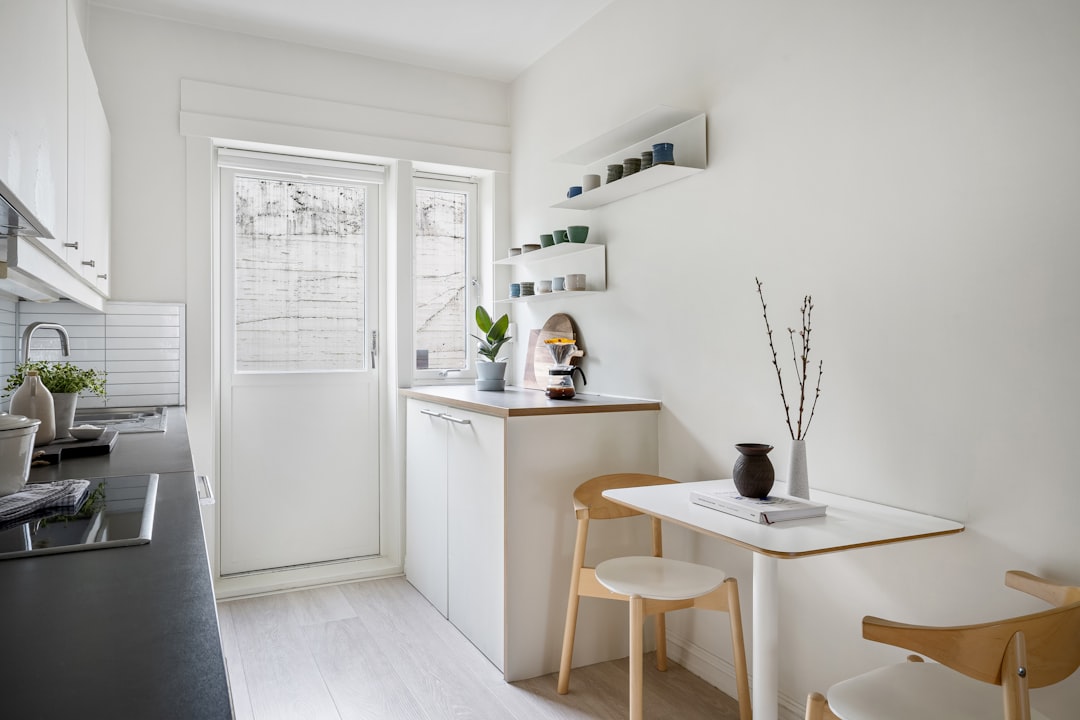
Idea 3 uses the end wall of a galley kitchen. Galley apartments have a built-in asset that goes unused in most setups: the short wall at the far end of the kitchen run. A wall-mounted fold-down table positioned here converts otherwise dead space into a working breakfast or dinner nook. You eat looking down the length of the kitchen, which sounds cramped until you try it and find it actually feels quite purposeful.
The table should not block the walkway when extended. In most galley layouts, this limits the table to 24 to 28 inches of width when the leaf is raised. Chairs that tuck completely under the table are essential here. Two floating shelves above the table for mugs, spice jars, or cookbooks reinforce the nook’s identity without adding any floor footprint.
Idea 4 applies specifically to kitchens with dark cabinetry or bold color choices. A pedestal-base drop-leaf table works better in these spaces than a four-legged version because the single center support keeps the floor visually open, which counteracts the visual weight of the dark cabinets. It also eliminates the corner-leg problem that causes daily shin collisions in narrow kitchen paths.
For stability, keep the extended leaf span on each side to no more than 10 inches beyond the base. Beyond that, the table becomes prone to tipping when someone leans on one side. The CB2 Midi pedestal table and the IKEA Docksta round tulip table are both solid choices in this category, and both seat two comfortably with room for a plant or candle at the center.
Idea 5: Small Apartment Dining Drop-Leaf Table in a Studio With No Dining Room

Studios present the starkest version of the dining problem. Your living room, bedroom, and kitchen are one rectangle. A permanent four-seat table takes floor space the sofa cannot spare. A drop-leaf or compact round table, positioned strategically, solves this without requiring a redesign of the entire layout.
The key in a studio is giving the table a defined corner rather than floating it in the center of the room. Push the table to the wall adjacent to the daybed or sofa with chairs on the outward-facing sides only. When the leaf is up, the corner reads as a dining area. When the leaf is folded against the wall, the table occupies the same visual footprint as a narrow console table.
Color consistency matters in this scenario more than in any other. If the sofa is white or light gray, pair it with a white or light-wood round table and chairs in complementary tones. Visual continuity across the single room is what prevents a studio from feeling cluttered. A round table with two accent chairs in a warm blush or earthy terracotta becomes an intentional design moment rather than leftover furniture.
For a deeper look at how to approach dining in an apartment with no dedicated room for it, see our guide on dining ideas for apartments with no dining room, and our breakdown of living room and dining room combo setups for open-plan spaces.
Ideas 6 and 7: Warm Wood Drop-Leaf Tables and Bench Seating


For Idea 6, the material finish of the drop-leaf table does significant heavy lifting. A table in oak, walnut, or acacia with visible natural grain reads as deliberate rather than budget-constrained, even in a small apartment. Pair it with white walls and white or light-gray kitchen cabinetry, and the warm wood becomes the single grounding element that anchors the dining corner without overwhelming the space.
Look for a rectangular drop-leaf in a natural wood finish where one side stays fixed against the wall and one side folds down. The fixed side always shows a usable surface, even when the leaf is down, which reinforces the table’s permanent status in the room. When guests arrive, raising the fold side takes the table from a narrow console to a full four-person dining surface in moments.
Idea 7 introduces a bench on the wall side. A simple bench, either bolted to the wall or freestanding at around 16 inches deep, adds two or three seats without requiring chairs that need to be pulled out and pushed in. The bench tucks completely under the table edge when the leaf is folded, contributing no dead space to the room.
Keep the bench cushion removable. A foam insert wrapped in a washable canvas or boucle cover adds comfort without requiring upholstered furniture in a space that probably already has enough fabric on the sofa. The cushion can store vertically behind the bench or in a nearby closet when the table is folded down.
Ideas 8 and 9: Alcove Tables and Making Your Drop-Leaf Look Intentional

Idea 8 applies to any apartment that has a narrow hallway nook, a window alcove, or a dead-end corner that seems too small for anything practical. A tulip-style round pedestal table at 20 to 24 inches in diameter fits precisely into these spaces and functions as a breakfast spot, a coffee zone, and a solo dining surface. At this scale, the table also works as a decorative element when not in use: a small vase, a candle, and two or three ceramics on the surface look intentional rather than provisional.
Pair the alcove table with a bench on the window side and one chair opposite. This creates the smallest functional two-seat dining setup in existence, with the bench providing window-seat energy even when no one is eating. The combination also photographs well, which matters if you ever want to make the space feel aspirational rather than cramped.
Idea 9 addresses the styling question that comes up with every drop-leaf table: how do you make a functional piece of space-saving furniture look like it belongs in a considered apartment?
The answer is four specific adjustments. First, anchor the table with a rug. A round jute or woven rug between 36 and 48 inches in diameter defines the dining zone on the floor and makes the table read as a permanent fixture. The rug stays visible even when the table is folded against the wall, which continues to signal “dining area” to anyone entering the room.
Second, position a light source directly above the table’s extended location. A pendant light, a sconce, or even an adjustable clip-on lamp creates a focal point that the table borrows. When the table is in its folded position, the light fixture alone marks the territory.
Third, keep the chairs cohesive. Two mismatched chairs work when the shapes and scales are similar: two different mid-century wood chairs look intentional. Two chairs from entirely different design families look like a storage problem. Choose chairs from the same visual era.
Fourth, use the table regularly. Set a candle and a small plant on it on nights you eat on the sofa. Keep a book or two on it over the weekend. A table that only comes out for actual meals reads as a piece of emergency equipment. A table that is part of the room’s daily rhythm reads as furniture. For more ways to furnish a small apartment with multi-purpose pieces, see our full guide on convertible furniture for small apartments.
The Takeaway
A drop-leaf table is not a lesser version of a real dining table. In a tiny apartment, it is the more intelligent choice: the piece that gives you the full function of a dining area without permanently sacrificing the floor space. The nine scenarios here cover the most common small apartment layouts, from the sub-80-square-foot galley to the studio with no dedicated dining room, and each one proves that the right table plus the right chair plus a few deliberate styling choices is enough to make dining in a small space feel genuine.
Focus on folded depth and hinge quality first. Style and size second. Chairs and rug last. Get those three layers right and you will not miss the dining room you never had.