21 Small Apartment Decor Tricks NYC Renters Swear By
NYC apartments come with their own set of constraints: no-paint leases, radiators that eat floor space, prewar layouts that make no logical sense, and rooms so compact your couch and your kitchen are separated by about three steps. Generic decorating advice almost never applies. These 21 small apartment decor tricks are pulled directly from what actually works inside the city’s tightest rentals.
The good news is that New York renters have spent decades solving the same problems, and the best solutions cost almost nothing. Here is everything that actually moves the needle.

Why Small Apartment Decor for NYC Renters Needs Its Own Rulebook
A 600-square-foot apartment in Austin is a starter home. A 600-square-foot apartment in New York is considered spacious. The mindset shift required for decorating small rentals in this city is significant: you are not trying to make a small space feel bigger as a style choice, you are doing it out of survival.
NYC rentals layer on constraints most renters outside the city never face: no-paint leases, prewar layouts with zero overhead lighting, radiators that cut off furniture placement options, and co-op buildings with rules against drilling. The tricks below account for all of these. Nothing here requires landlord permission or a budget over $200 per upgrade.
1. Think Vertical: Push Storage to the Ceiling
Floor space is the most expensive real estate in a New York apartment. Wall space above eye level is essentially free, and most renters ignore it completely. Shifting your storage and decor upward is the single highest-leverage move in a small apartment.

Specific ways to go vertical without drilling:
- Freestanding ladder shelves that lean against the wall. The IKEA SVALNÄS or any narrow metal ladder shelf works well. They hold 50 to 60 pounds without a single anchor bolt.
- Bookcases pushed together and stacked. Two IKEA KALLAX units stacked vertically with a small ledge at the top create a floor-to-ceiling storage wall that also acts as a room divider.
- Over-door organizers on every door: bedroom, bathroom, closet, and pantry. Each one recovers 8 to 12 inches of depth that the door space was wasting.
- Tension pole shelving systems in corners. These wedge between floor and ceiling with no hardware and add 3 to 5 shelves in a footprint of about 12 by 12 inches.
- Wall-mounted hooks installed with adhesive. 3M Command Large Hooks hold up to 7.5 pounds each. A row of five along your entryway wall handles coats, bags, keys, and umbrellas without a single nail hole.
When shelves go above 6 feet, keep the top shelf decorative only: plants, baskets, stacked books with spines facing out. Save the accessible zone between waist height and eye level for things you actually reach for daily.
2. Use a Mirror to Double Your Visual Space
A large mirror is the cheapest square footage you can add to a New York apartment. A floor-length mirror leaning against a wall, a 24-by-36-inch framed mirror above a console, or a round mirror hung at the end of a narrow hallway all do the same thing: they bounce light, create a sense of depth, and make the room read as twice the size.

Rules for using mirrors effectively in a small NYC apartment:
- Position mirrors opposite a window, not opposite a wall. A mirror facing a window reflects daylight back into the room and doubles the effective brightness.
- For leaning mirrors, the ideal position is in the corner of your living room or bedroom at a slight outward angle. This creates depth in two directions at once.
- Go bigger than feels comfortable. A 30-by-40-inch mirror looks massive in a store and perfect on a wall. The smaller mirrors look decorative but do nothing for the scale of a room.
- In a studio, a tall mirror at the end of the longest sight line (often from the door toward the far wall) creates the illusion that the apartment continues further than it does.
- IKEA NISSEDAL mirrors are 18 by 26 inches and cost $25. Two hung side by side create a 36-by-26-inch visual that reads as a single large piece.
3. Make Every Piece of Furniture Earn Its Place
In a 400-square-foot apartment, a piece of furniture that serves only one purpose is a liability. A sofa that is just a sofa, a coffee table that only holds a coffee mug, or an ottoman that only gets sat on: these are all floor space wasted in a city where floor space is measured in hundreds of dollars per square foot.

The NYC renter’s furniture checklist:
- Coffee tables with drawers or shelves underneath. The IKEA HEMNES coffee table has two drawers. The West Elm Patchwork table has a lower shelf. Either one stores blankets, remotes, chargers, and books off the floor.
- Ottomans with internal storage. A 20-by-20-inch cube ottoman at $40 to $80 holds extra pillows, off-season accessories, or guest bedding and does triple duty as seating, footrest, and coffee table.
- A dining table that folds flat. A wall-mounted fold-down desk with brackets holds 200 pounds open and lies flat against the wall closed. It works as a desk, a dining table for two, and disappears when not needed. See more options in our guide to convertible furniture for tiny apartments.
- A bed frame with under-bed drawers. In a small bedroom, under-bed storage can replace an entire dresser. The space under a queen bed holds 6 to 8 standard under-bed bins.
- A console table behind your sofa. In a studio, a narrow console (10 to 14 inches deep) behind the sofa creates a visual barrier between sleeping and living zones while serving as a surface for lamps, plants, and books.
4. Use a Rug to Define Zones and Add Color
In a studio or open-plan apartment, rooms are created by implication rather than walls. A rug is the primary tool for implying that a specific zone exists. Without a rug, a studio reads as one undifferentiated space. With two rugs, it clearly has a living room and a sleeping area, even if they are separated by four feet.

Rug sizing is where most NYC renters go wrong. The rules:
- In a living room, the rug needs to fit under the front two legs of the sofa at minimum. For a 7-by-9-foot living area, that means a 5-by-8-foot rug at the smallest. An 8-by-10-foot rug that fits under all four legs looks proportional and pulls the furniture together.
- In a studio, use a second smaller rug (4-by-6 feet) under the bed with just the front legs on it. This visually separates the sleeping zone without any physical division.
- Natural fiber rugs (jute, sisal, seagrass) are the most budget-friendly at $80 to $150 for a 5-by-8-foot size. They do not compete visually with patterned cushions or art.
- For renters with original hardwood floors, a rug pad is non-negotiable. It stops the rug from sliding, protects the floor, and cushions sound to the apartment below, which matters enormously in New York buildings.
5. Stop Battling Your Windows: Let the Light Lead
New York apartments are famous for their window situations: one window that faces a brick wall two feet away, north-facing rooms that never see direct sunlight, or windows at the back of a railroad apartment that light exactly one room. Working with your light rather than around it changes the feel of a rental immediately.

Window tricks that work specifically in NYC rentals:
- Hang curtain rods 4 to 6 inches above the window frame (or as close to the ceiling as possible) and use curtains that reach the floor. This makes 48-inch-tall windows read as 84 inches. Use a tension rod inside the window frame so no screws touch the wall, or use 3M adhesive curtain rod brackets.
- Swap opaque blinds for sheer white curtains in rooms that face a brick wall or airshaft. Sheer curtains let diffused light through while softening the view.
- Use the windowsill as a plant shelf. Deep sills common in prewar buildings hold 4 to 6 small plants in a row. Plants at the window soften the boundary between inside and outside and add life to a dark room.
- For apartments with a north-facing exposure, a daylight-spectrum bulb (5000K to 6500K) in every lamp compensates for the blue, flat quality of northern light. Pair with warm-toned accessories to prevent the room from feeling clinical.
- Remove or raise the bottom sash on double-hung windows. Most NYC prewar windows were designed to open from the top for airflow. Opening just the top half brings in more light while keeping the curtain in place.
6. Turn Your Walls Into Your Main Decor Investment
When floor space is limited, walls become the primary canvas. In a small NYC apartment, bold wall decor does more for the room than any piece of furniture. It costs less, takes up zero floor space, and is the most visible thing in the room at any given moment.

Wall decor options that work in no-drill or no-paint NYC rentals:
- Picture ledges. IKEA MOSSLANDA ledges install with two screws per shelf (small holes) and hold 6 to 8 frames per 45-inch shelf. The advantage is that you can rearrange the art without touching the wall again. For a full walkthrough, see our guide to renter-friendly gallery wall ideas.
- Peel-and-stick wallpaper on a single accent wall. This is now widely understood to be removable from most painted surfaces. It comes off cleanly and adds huge visual impact. Limit it to one wall to keep the room from shrinking further.
- Large-format art prints from Poster Hanger, Society6, or Desenio. A single 24-by-36-inch print hung with two strips of adhesive picture hardware becomes an instant focal point. Total cost: $20 to $40 for the print and $5 for the hanging hardware.
- Woven wall hangings on a dowel. A macrame or woven textile piece hung from a wooden dowel with string can be mounted over a finishing nail or even a pushpin rated for 1 pound. No Command strips needed.
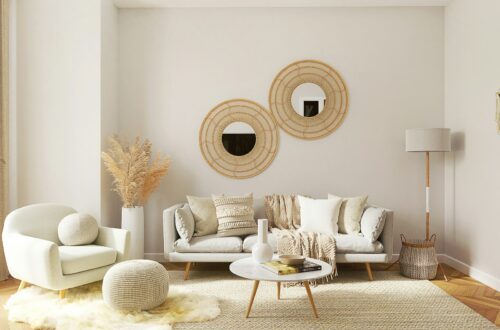
- Mirrors as art. A cluster of three round mirrors of different sizes hung in a loose triangle reads as intentional art while also expanding the room.
7. Renter-Friendly Kitchen Upgrades Under $100
NYC apartment kitchens come in two styles: galley kitchens the width of a hallway, and slightly larger galley kitchens. Neither has enough counter space, and most have cabinets that date to the building’s last renovation in the 1980s. The good news is that kitchens respond dramatically to small, cheap, reversible changes.

The most impactful reversible kitchen upgrades:
- Peel-and-stick contact paper on cabinet fronts. A 17-inch-wide roll of marble or wood-grain contact paper costs $12 to $20 and covers 4 to 6 standard cabinet doors. Remove it cleanly when you move out. The transformation is dramatic.
- Adhesive backsplash tiles. Peel-and-stick subway tiles or mosaic panels install in under an hour and come off with a heat gun or warm water. A 12-by-12-inch panel costs $3 to $6, and a standard backsplash takes 20 to 30 panels.
- Magnetic spice rack on the refrigerator. Every square inch of counter space freed up is worth recovering. A set of 4 to 6 magnetic spice tins on the side of the fridge holds a full spice collection and costs $15 to $25.
- Under-shelf baskets. These slide over wire or solid shelving in cabinets and add an extra storage layer inside each cabinet. A pack of 2 costs $12 to $18.
- A butcher block or cutting board that bridges the sink. Placed across the top of your sink when not in use, it adds 6 to 10 inches of prep space and costs $30 to $50.
8. Small Bathroom, Maximum Personality
NYC apartment bathrooms are usually one of three configurations: a narrow rectangle with a tub and no storage, a slightly less narrow rectangle with a tub and no storage, or (in newer buildings) a cramped wet room. In all three cases, the walls and vertical surfaces are the only usable real estate.

Bathroom upgrades that leave no trace:
- Swap the shower curtain. A new shower curtain and matching rings cost $30 to $60 and change the entire color story of the bathroom. Keep the original in a bag to reinstall before move-out.
- Add a freestanding towel rack or ladder. A slim towel ladder in the corner adds storage and warmth without touching the walls. Bamboo versions cost $25 to $45.
- Install a tension-mounted shower caddy. No drilling, holds 10 to 15 pounds, adjusts to fit most tubs and showers. Clears the tub ledge and shelf of all the clutter that makes a small bathroom feel chaotic.
- Replace the toilet paper holder with an adhesive version if yours is missing or broken. 3M adhesive holders rated for 5 pounds are available at Home Depot for $8. Patch the existing holes when you install it.
- Add a trailing plant. A pothos in a corner or on top of the toilet tank thrives in the humidity of a bathroom and adds life to an otherwise entirely hard-surfaced room. No sunlight required.
- Use a large framed mirror or a leaning mirror to visually expand the space. A 24-by-36-inch mirror leaning against the back wall behind the toilet makes even a 40-square-foot bathroom feel workable.
Four habits that cost nothing but preserve everything you have built: use a one-in, one-out rule so the apartment never fills past capacity; keep all surfaces at 30 percent capacity so negative space stays visible; use consistent storage containers (matching bins read as organized, random boxes read as clutter); and hang a command hook near the entry so bags go there instead of a chair. For a full budget approach to a new NYC rental, see our guide to furnishing your first apartment for under $1,000.
The Takeaway
Small apartment decor for NYC renters comes down to three core principles: use vertical space that you are currently ignoring, make every purchase serve more than one function, and accept that walls are your primary decorating canvas when floors are limited. Apply these 21 tricks in sequence, starting with the changes that cost nothing (furniture rearrangement, storage consolidation), and work toward the upgrades that require a modest investment. None of these tricks require permission from your landlord, and all of them reverse cleanly when you move.
The best NYC apartments do not feel small because their occupants refuse to accept that constraint. They feel curated and intentional. That is a decision, not a budget.
Related reading: