15 Clever Ways Couples Can Share a Tiny Studio Apartment Without Killing Each Other

Two people. One room. No walls. Sharing a studio apartment as a couple is one of the trickiest living situations you can sign yourself into, and the couples who make it work share one thing in common: they treated the space as a design problem, not a storage problem. The good news is that small apartment decor for couples does not require a bigger budget or a bigger apartment. It requires smarter decisions about zones, furniture, storage, and the few house rules that actually matter. Here are 15 concrete ways to make it work.
Why Small Apartment Decor for Couples Is a Different Challenge

When you live alone in a studio, a little clutter or a mismatched sofa is nobody’s problem but yours. Add a second person and every decision becomes a negotiation. The couch that was fine for one now needs to sleep a guest. The single desk that worked for solo evenings suddenly competes for screen time. The closet that held one wardrobe now needs to hold two.
The couples who do this well start by accepting one core rule: you cannot treat a shared studio like a bigger version of your solo space. You need to design for two from the start, with dedicated zones for each person’s habits and clear systems that do not rely on either person being unusually tidy.
- Each person needs at least one space that is visually theirs
- Shared surfaces require shared rules about how they get used
- The sleeping zone, work zone, and social zone each need physical definition
- Storage has to be designed for two wardrobes, not one
- Compromise on aesthetics matters more than either person winning
The good news is that studios force a kind of efficiency that larger apartments do not. You cannot waste space, which means you end up with a more thoughtfully arranged home than most one-bedroom renters ever achieve.
Define Zones With Rugs, Lighting, and Furniture Placement

The single most important thing you can do in a shared studio is establish clear zones before you move in a single piece of furniture. Zones do not require walls. They are created by three elements: rugs, lighting, and the backs of furniture.
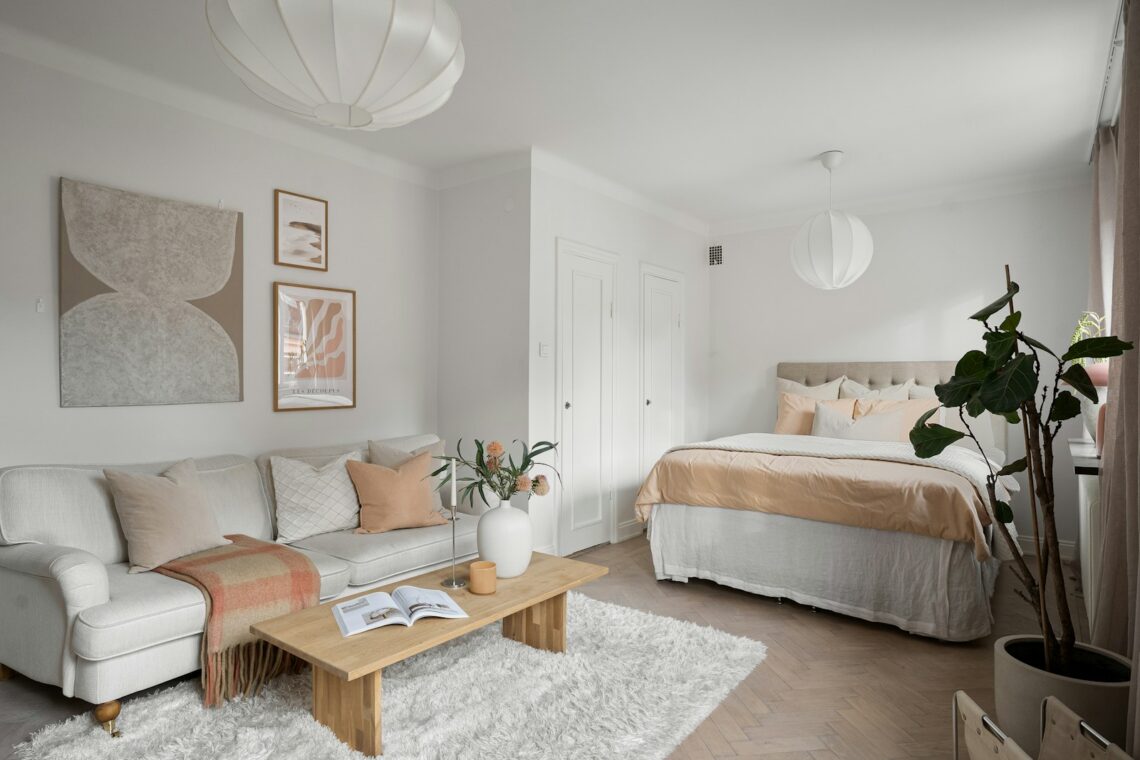
A large area rug under the sofa signals this is the living zone. A pendant lamp above a small table signals dining area. The back of a bookshelf or sofa facing the bed signals sleeping zone. Together they create psychological separation that your brain interprets as distinct rooms even when the square footage says otherwise.
- Use a rug at least 8 by 10 feet to anchor the living area and define its boundaries
- Hang a ceiling fixture or plug-in pendant over the dining spot rather than relying on overhead lighting for everything
- Face the sofa toward the TV or window, not toward the bed, so the two zones feel like separate directions
- A tall bookshelf or open shelving unit placed between bed and sofa functions as a soft divider without blocking light
- Curtains on a ceiling-mounted rod are the fastest and cheapest way to create a bedroom zone you can close off
For more specific options on using curtains to divide your space, the detailed guide on curtain dividers for studio apartments covers ceiling track systems, IKEA hardware, and sheer versus blackout panels. The bookshelf approach is covered in depth in this piece on bookshelf room dividers for studios.
Choose Furniture That Does Two or Three Jobs
Every piece of furniture in a couples studio needs to justify its footprint. The sofa that only sits? Replace it with a sofa bed for guest nights. The coffee table that only holds remotes? Swap it for one with hidden storage. The bed frame that has nothing underneath? Replace it with a platform with drawers.
Convertible furniture is not a compromise. The best convertible pieces are indistinguishable from regular furniture until you need them to transform, and they give you back square footage you would otherwise lose to dedicated single-purpose items.
- A storage ottoman does triple duty: seating, foot rest, and hidden storage for blankets or books
- A drop-leaf dining table folds flat against the wall on days you do not need the full surface
- A platform bed with built-in drawers eliminates the need for a separate dresser in many cases
- A daybed can serve as both sofa and guest bed without taking up extra space
- Murphy beds are the nuclear option, but they free up the entire floor plan during waking hours
For a full breakdown of the best space-saving pieces available right now, the guide to convertible furniture for small apartments is worth reading before you buy anything.
Solve the Storage Problem Before You Unpack a Single Box

Most couples moving into a studio together are merging two full wardrobes, two sets of kitchen gear, two book collections, and two people’s worth of random objects. Before any of that goes in, you need a storage plan. Not a vague intention to stay organized but a specific, mapped-out system with a designated spot for every category of item.
The starting point is almost always the closet. If you only have one closet between two people, you need to treat it like a shared resource with fair allocation, not a first-come first-served situation. Divide the hanging rod in half. Each person gets their half and manages it. Shared items like bed linens and towels go on shelves at the top.
- Over-door organizers add instant vertical storage without drilling any holes
- Under-bed storage bins on wheels slide out easily for seasonal items or spare bedding
- Floating shelves above the bed give a nightstand-free sleeping area that still holds books and lamps
- A freestanding wardrobe or PAX system from IKEA adds a full second closet for under $300
- Slim rolling carts that fit beside the fridge or between appliances capture kitchen storage you are currently ignoring
For the full tactical breakdown of how couples actually split one small closet without resentment, check the in-depth piece on sharing one closet as a couple. It covers dividers, labeled bins, and the rule about seasonal rotation that most couples skip and then regret.
Give Each Person Their Own Dedicated Desk Corner

If either or both of you work from home, or even just regularly brings work home, a dedicated desk each is not a luxury. It is the difference between a functional studio and a miserable one. Sharing a single desk sounds fine until you both need it at the same time for a Zoom call.
Two desks in a studio sounds impossible until you start thinking vertically. A narrow wall-mounted shelf at standing height works as a standing desk. A fold-down murphy desk takes up no floor space when not in use. A loft bed with a desk underneath turns the sleeping area into two zones stacked on top of each other.
- Wall-mounted fold-down desks start around $80 and fold flat when not in use
- A small secretary desk with a hinged front gives a dedicated workspace plus hidden storage in under 18 inches of wall width
- Two narrow desks placed side by side along one wall use less space than many entertainment centers
- Noise-canceling headphones are not a desk upgrade but they are the single best investment for two people working in one room
- If one person primarily needs a desk for evening tasks, a tray table stored behind the sofa is genuinely enough
The full guide to building a work from home setup in a studio apartment covers monitor placement, cable management, and how to mentally clock out when your office is four feet from your bed.
Run a Kitchen Built for Two People

Studio kitchens are almost always galley-style, meaning one cook at a time is the functional maximum. When two people want to cook together or prep simultaneously, the kitchen becomes a source of real friction unless you set it up correctly from the start.
The goal is to keep every countertop surface as clear as possible so that whoever is cooking has room to actually work. That means moving everything that does not get used daily off the counter and into drawers, cabinets, or vertical storage on the wall.
- A magnetic knife strip on the wall takes knives off the counter and frees up a full cutting board’s worth of space
- Command hooks on the inside of cabinet doors hold measuring cups, graters, and small tools that eat up drawer space
- A pot rail or S-hook bar mounted above the stove keeps cookware accessible without a cabinet
- If counter space is genuinely too small, a rolling kitchen cart adds prep space that stores in a corner when not needed
- Agree on a rule: the person who cooks does not clean, and the person who cleans does it within one hour of the meal ending
The last point is less about decor and more about domestic sanity. In a studio where the kitchen is visible from the sofa, a pile of dishes is not just a kitchen problem. It is a living room problem too.
Create a Shared Living Space You Both Actually Like

The living zone is the one area of the studio that truly belongs to both of you equally. Neither person gets to dominate it. This makes it the most politically charged surface in the entire apartment, and also the area most worth spending real thought on before you start shopping.
The best approach is to each identify your two or three absolute requirements, then find solutions that satisfy both lists. One person needs good reading light. One needs the TV to be visible from the couch. One needs somewhere to put their feet up. These requirements usually have overlapping solutions once you map them out together.
- A sectional sofa gives each person their own corner so neither is always squished against the other
- A pair of matching floor lamps on opposite ends of the sofa serves both a reader and a TV watcher
- Choose a coffee table with a lower shelf so both people can park their items without the surface becoming contested territory
- A console table behind the sofa doubles as a workspace for the person who needs to spread out papers or a laptop
- One gallery wall or one large art piece above the sofa is easier to agree on than scattered individual frames
If the living room and dining room are competing for the same square footage, the guide to living room dining room combos in small apartments has specific layouts and furniture combinations that work for the overlap.
Bring in Personality Without Decorating by Committee

One of the quiet tensions in couples studios is that the space ends up feeling like nobody’s home because every decorating choice had to survive two veto rounds. The result is a neutral, inoffensive apartment that neither person is excited to come home to.
The fix is to agree on the large decisions together, then give each person autonomous control over a specific zone or surface. One person manages the bookshelf styling. One person picks the plants. One person handles the bathroom. These individual zones make the space feel genuinely lived-in by two actual humans rather than two people trying not to offend each other.
- Indoor plants are almost universally agreeable and they make any space feel more alive regardless of the existing style
- Personal books, records, or objects displayed on open shelving signal individuality without requiring agreement on a style
- A throw blanket in each person’s preferred color on the sofa is a small thing that makes both people feel at home
- Let one person pick the art for the bedroom wall and the other pick the art for the main living wall
- Avoid decorating from a single matching set: two people’s collected items always look more interesting than a coordinated package deal
The Ground Rules That Actually Prevent Real Fights

No amount of good design fixes a fundamental mismatch in how two people treat shared space. The couples who survive studio living long-term have almost always had explicit conversations about expectations that most couples only get around to having after the first real argument.
These conversations do not need to be heavy. They just need to happen before the habits set in. A 20-minute talk about cleaning expectations and alone-time needs during the first week will prevent a dozen arguments over the next year.
- Alone time: if one person needs quiet time to decompress, establish a signal like headphones in means do not disturb rather than expecting the other person to guess
- Morning routines: in a studio with one bathroom, staggered wake-up times by even 15 minutes prevent the biggest daily collision point
- Cleaning threshold: define what counts as clean before you move in together rather than discovering you have different definitions three months later
- Guests: agree in advance on how much notice is required before bringing someone home, and how long guests can stay before it starts to feel like a third roommate situation
- Noise: work schedules differ, and what one person needs as background noise while working is another person’s concentration killer, so a basic courtesy protocol about headphones and call times matters more in a studio than anywhere else
The most important thing is to revisit these rules every few months. What works when you first move in often shifts as work schedules change, routines develop, and both people settle into the space differently.
Small Apartment Decor for Couples: Putting It All Together
A studio that works for two people is not the result of buying the right furniture. It is the result of making decisions in the right order: zones before furniture, storage before unpacking, shared systems before individual habits, and honest conversations about expectations before the resentment has a chance to build.
The 15 ideas in this guide are not about making a small apartment feel large. They are about making two people feel at home in the same small space. That is a different goal, and it turns out to be an achievable one once you stop fighting the square footage and start designing around it.
The Takeaway
Couples who thrive in tiny studios share one habit: they made design decisions together before they moved in, not after. Zones, storage systems, dual desks, and a handful of clear house rules transform a single room into a space that genuinely works for two people. Start with zones, solve storage early, and give each person at least one surface that is entirely theirs. Everything else follows from there.